No Work-Life Balance for Hybrid Entrepreneurs? My 2am Take On It….
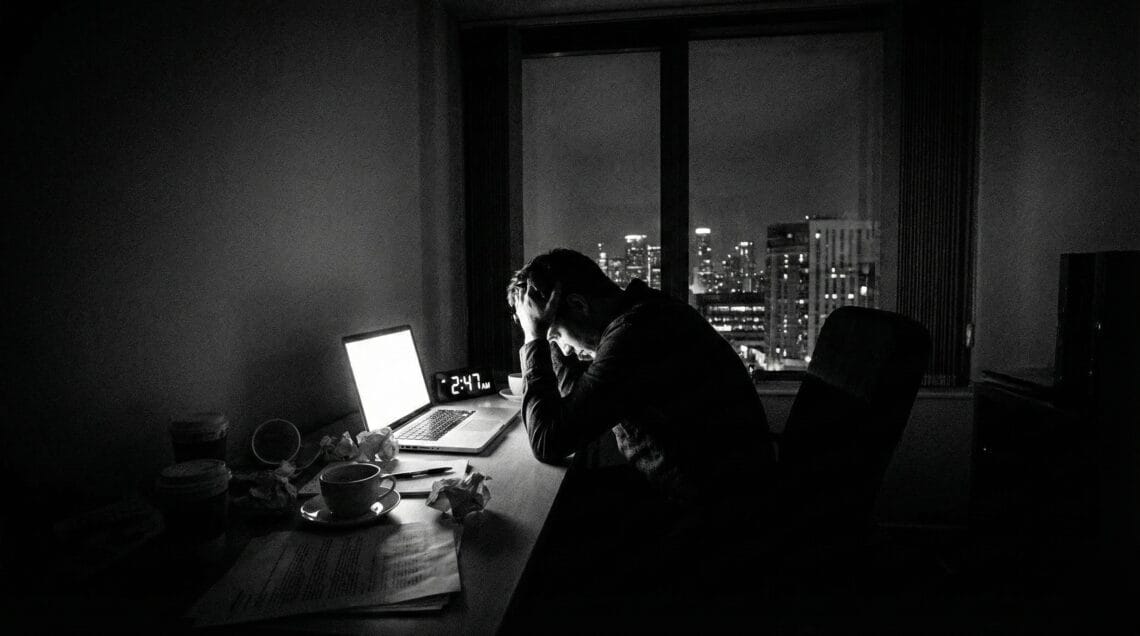
It’s 2:47 AM….Again…. The house is silent except for the hum of my laptop, the dog snoring, and the occasional click of my keyboard. My family sleeps upstairs while I’m down here, eyes burning, working on what I’m calling “my business”, though honestly, some nights like tonight I’m not even sure what to call it anymore. A side hustle? A future empire? A slow descent into unavoidable caffeinated madness? Is no work-life balance even sustainable at my age?

Tomorrow, or technically today, I have an important meeting for which thankfully I already prepped and analyzed all data for. That gives me plenty of tonight time to work on my unbeatable business ideas that will make me a millionaire.
Yesterday I told myself “Tonight I’m going to bed early!”…that clearly didn’t happen. Two days ago, same thing….Last week, I fell asleep while watching Bluey with my daughter. I keep asking myself: what the hell am I doing?
But…if you’re reading this at an ungodly hour, working on your “thing” while everyone else dreams and snores, you already know how it feels… To me, it feels like climbing a mountain, being an employee that loves his job and gives it all to help the team, being a “fearless” entrepreneur, a parent, and, sometimes, a functioning human being…all at once.
The Data on Hybrid Entrepreneurs: You’re Not Alone (But You Are Screwed)
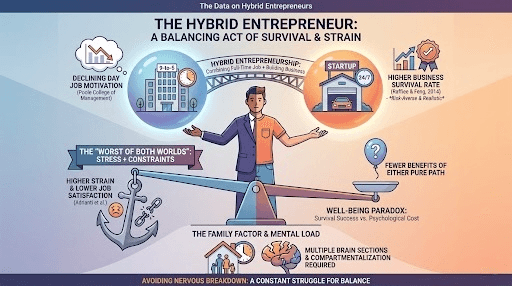
As the good scientist that I am (or try to be), I found that there is quite a bit of actual research done around the entrepreneurship lifestyle. Turns out you and I are part of a something called hybrid entrepreneurship, aka combining full-time employment with building a business. Take that multitasking!
A 2013 study published in the Academy of Management Journal found that people who start businesses while keeping their day jobs actually have higher survival rates than those who quit and jump in full-time. Basically it seems that hybrid entrepreneurship together with prior experience is the golden ticket. You heard it right.
we argue and find that hybrid entrepreneurs who subsequently enter full-time self-employment (i.e., quit their day job) have much higher rates of survival relative to individuals who enter full-time self-employment directly from paid employment.
(Joseph Raffiee and Jie Feng, Academy of Management Journal, Vol. 57, No. 4)
The same research also says that hybrid entrepreneurs are more risk-averse but also more realistic, basically they know or make an educated observation on how brutal entrepreneurship can be, so they hedge their bets.
But here’s where it gets messy. A study on psychological well-being found that hybrid entrepreneurship results in higher strain levels and lower job satisfaction compared to either full-time employment or full-time self-employment. We’re living in the worst of both worlds—the stress of entrepreneurship plus the constraints of employment, with none of the benefits of either.
the positive association between self-employment and psychological well-being is more apparent in fulltime self-employment than in hybrid mode
(Retno Adrianti et al. Journal of Business Venturing Insights)
Research from NC State’s Poole College of Management shows that hybrid entrepreneurs experience declining motivation at their day jobs over time, which makes sense when half your brain is building one thing and the other half is building another thing.
I also believe that this becomes even harder when you account for family time. Then, your brain has to split into multiple sections, and you gotta be REALLY good in compartmentalizing to avoid a nervious breakdown.
Kevin O’Leary’s Brutal Honesty: There Is No Balance
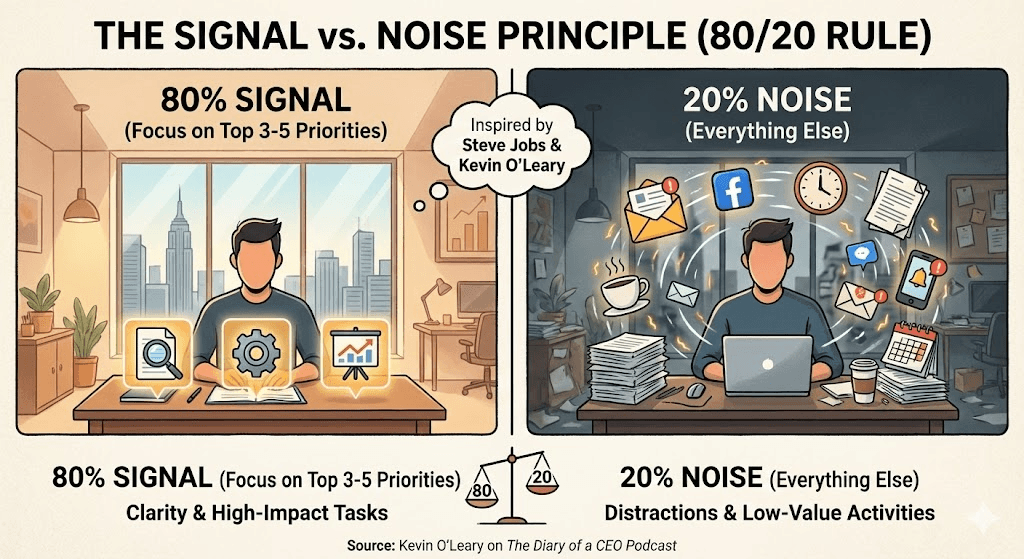
I listen to a lot of podcasts while driving, walking the dog, or working out. A couple weeks ago I got to Kevin O’Leary’s interview on The Diary of a CEO, and Mr. Wonderful mentioned something important: signal versus noise. O’Leary learned this from Steve Jobs, who demanded an 80/20 ratio—80% of your waking hours focused on your top 3-5 priorities (the signal), and only 20% on everything else (the noise).
When Steven Bartlett asked about work-life balance, O’Leary said he hires managers who balance business discipline with creative pursuits, photography, guitar, watchmaking, marathon runners (I don’t remember if he mentioned runners but I’ll add it in since I love running).
But what’s missing? He’s not juggling a full-time job, your kids’ bedtime routines, preparing dinner, washign dishes, doing laundry, taking care of the pets…oh yes… and a midnight database error that may screw up you SaaS idea, or a competitor that “just has what you need…”….
But Kevin O’Leary also openly says that in the same day, he may receive news that a company is going bankrupt (losing $10 million) and half an hour later, another is going public with a 450X return. That’s entrepreneurship at scale.
For hybrid entrepreneurs, that chaos gets compressed into stolen hours at lunchbreak or between midnight and dawn.
When Do I Sleep? The Science Is Quite Brutal…
And here we are…Let’s talk about the elephant in the room: sleep. Or rather, the lack of it. My wife tells me I don’t sleep enough, my physicican tells me the same thing…I tell myself the same thing…and yes, I’m stubborn. Or stupid, you choose.
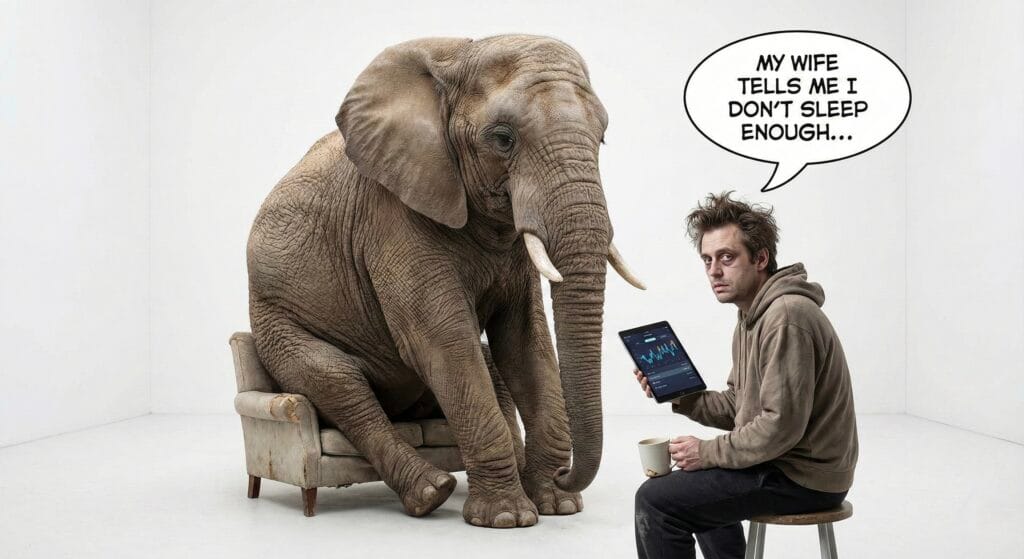
A 2019 study published in the Journal of Risk and Financial Management found that insomnia significantly impacts entrepreneurs’ health through increased stress and negative affect. After analyzing data from 152 Iranian entrepreneurs, the authors actually suggest that more sleep, instead of other stress reduction techniques, can be a panacea for reducing stress.
The research on sleep deprivation shows it demolishes your decision-making, creativity, energy levels, and ability to spot promising opportunities. The study published in the Journal of Business Venturing in 2019 is quite clear about it:
Results from three studies, including a self-comparison study over time and a randomized sleep deprivation experiment, show that a good night of sleep positively influences entrepreneurs’ abilities to perform cognitive tasks at the very basis of entrepreneurial pursuits, whereas shortchanging sleep can yield suboptimal performance.
(Journal of Business Venturing, Volume 34, Issue 6, November 2019, 105943)
A meta-analysis of 19 studies involving 1,932 participants found that sleep deprivation strongly impairs human functioning. Not a brainer, however: mood is more affected than cognitive or motor performance, and partial sleep deprivation (the kind we hybrid entrepreneurs experience chronically) has a more profound effect than either short-term or long-term total sleep deprivation.
Read that again. The 4-5 hours you’re getting, or I am getting, nightly is worse for your performance than pulling an all-nighter would be.

Research from Johns Hopkins Carey Business School shows that poor sleep results in diminished creativity, increased exhaustion, poor performance, and suboptimal decision-making capacity. They report howit could even cause ADHD-like symptoms, pushing entrepreneurs to make wrong decisions and taking stupid risks when they shouldn’t.
In fact, temporary sleep problems can actually prompt ADHD-like behaviors that encourage entrepreneurial action. Sleep deprivation creates impulsivity that can push people to finally launch their ventures. But there’s a dark side—existing entrepreneurs are more likely to start additional businesses after experiencing sleep problems, creating a vicious cycle
Even worse…Two U.S. studies surveying self-employed individuals (105 and 329 respondents) found that poor sleep leads to feeling demotivated, depleted, and overly fatigued, with little focus during the workday.
The American Academy of Sleep Medicine recommends seven to eight hours of sleep per night for peak performance. Most hybrid entrepreneurs I know—myself included—are lucky to get five.
Did You Know?
A study at the Israeli Air Force found that cognitive performance significantly declines after just 20 hours of wakefulness.
Yet many hybrid entrepreneurs routinely operate on 18+ hour days multiple times per week
Is It Normal to Keep Asking “What the Hell Am I Doing?”
Short answer: yes..or at least that’s what I tell myself…. Long answer: it’s not just normal, it’s rational.
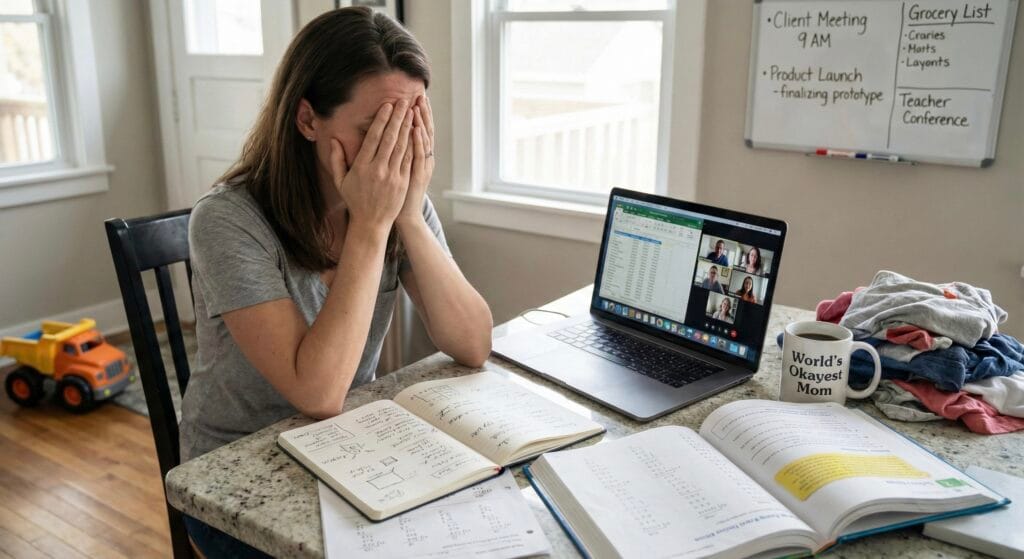
Here’s what the research doesn’t often capture : the constant second-guessing is part of the process. You’re simultaneously trying to succeed in two different domains that have completely different metrics, timelines, and definitions of success.
Tricia Shinelle Alleyne from the Department of Pediatrics, Division of Critical Care, University of Tennessee Health Sciences Center says how we should strategically plan our career goals while our personal lives “often happen as an afterthought.” The researcher asks: “Can we succeed if we excel in one area of life and the rest is in shambles?” Work-home conflicts resolved in favor of work are among the top three contributors to burnout.
Rachel Stark,Program Director, Internal Medicine Residency Program, Cambridge Health Alliance, and Instructor of Medicine, at Harvard Medical School, wrote about working from home during the pandemic while single-parenting two elementary-aged children, describing how “all boundaries and definitions are blurred, melting into each other.” She describes helping her daughter with long division while on call, ICU capacity at 200%, feeling “painfully pulled in so many directions.”.
The Reality Nobody Posts on LinkedIn
Here’s what the research reveals about what actually happens to hybrid entrepreneurs:
Studies show that salary from employment supports novice entrepreneurs in overcoming the “liabilities of newness and smallness.” Hybrid entrepreneurs are more likely to act as bricoleurs making do with resources at hand rather than raising capital.
But recent research on role demands found that caring responsibilities and rigid work hours in day jobs negatively moderate the relationship between hybrid entrepreneurship and well-being. For female hybrid entrepreneurs, caring responsibilities have the strongest negative effect. For male hybrid entrepreneurs, rigid work hours are the primary stressor.
a positive relationship between hybrid entrepreneurship and subsequent well-being in full entrepreneurship requires hybrid entrepreneurs’ ability to transform their experiences of running their own business and coping with feeling stressed into skills that protect their well-being in full entrepreneurship.
(Hybrid Entrepreneurship and Entrepreneurs’ Well-Being: The Moderating Effect of Role Demands Outside Entrepreneurship – Entrepreneurship Theory and Practice, Volume 49, Issue 3)
| Research Finding | Source | Implication for Hybrid Entrepreneurs |
|---|---|---|
| Partial sleep deprivation worse than acute deprivation | Sleep meta-analysisacademic.oup | Chronic 4-5 hour nights cause more damage than occasional all-nighters |
| Higher strain, lower satisfaction than either full-time option | Psychological well-being studysciencedirect | You’re not imagining it—this path is objectively harder |
| Higher survival rates after transition | AMJ studyjournals.aom | The struggle now pays off if you make it to full-time |
| Declining motivation at day job over time | NC State researchpoole.ncsu | Your employer will notice; plan accordingly |
The Questions You’re Actually Asking at 3 AM
Am I destroying my health for something that might fail?
Possibly. Research from 2010 on chronic sleep loss found that even when circadian rhythms are at their peak (late afternoon), reaction times and performance are compromised under chronic sleep restriction. The dangerous part? You may not realize how impaired you are. The study warns that “workers who need to remain awake for extended periods cannot maintain normal performance and may not be aware of this vulnerability if they are suffering from chronic sleep loss.”
You’re making critical business decisions and parenting decisions while cognitively impaired. That’s the reality.
Can I fin an actual work-life balance?
A piece on work-life balance in medicine notes it’s “not about missing that one big life event, but about missing all those little moments that shape a child’s formation.” Research confirms that resolution of work-home conflicts in favor of work is a top contributor to burnout.
The data doesn’t lie: something will give. The question is whether you’re making that choice consciously or letting it happen by default.
Can I actually pull this off?
The honest answer from research: maybe..and I ask this myself every day. But data are clear, 60-80% of startups fail. But research also says that hybrid entrepreneurs who transition to full-time have higher survival rates than those who jump directly into entrepreneurship.
You’re essentially paying for an extended runway with your sleep, sanity, and family time. Whether that’s worth it depends on what you’re building and why.
What Does Research Say About Making Hybrid Entrepreneurship Work
None of this is probably new stuff that you have never heard, however, there’s some reassurance in putting it all together.
1. Time-box the crap out of your 80/20 signal ruthlessly
O’Leary’s signal-to-noise framework has research backing. Studies on time management show that when we accept we’re chasing the impossible, we can relieve ourselves of impossible expectations. Define your 3-5 critical tasks for the 18 hours you’re awake and protect them fiercely.pmc.ncbi.nlm.nih
2. Your personality can work—stop trying to be someone else
Research shows multiple personality patterns succeed in entrepreneurship. Your risk-aversion and analytical nature as a scientist aren’t liabilities—they’re why you chose the hybrid path, which has higher success rates upon transition. Stop reading books telling you to “think like Zuckerberg” and start using your actual strengths.
3. The sleep thing is non-negotiable
While I do keep fighting this and I probably still live in denial..every single study I found agrees: sleep deprivation impairs entrepreneurial decision-making, reduces opportunity recognition, and makes you dumber. When I was in college I kept saying “I’ll sleep when I’m dead”, and doing it now is not too smart…that literally kills businesses and people
4. Set realistic timelines
Research on female entrepreneurs shows they set achievable growth targets (15-16% vs. 30% for men) and hit them 90%+ of the time versus 65% for men. This keeps teams engaged and creates momentum. Stop setting targets that require you to be superhuman.singjupost
5. The math on exits matters
Studies confirm that some hybrid entrepreneurs never intend to go full-time, and I may be in that slice myself. Some want stability and hedging risks with a side income. That’s cool. Others use the hybrid phase to test stuff out and build momentum, buffer, capital, and resilience before transitioning. Know who you are, because the strategies differ.
The Uncomfortable Truth of Hybrid Entrepreneurship
Here’s what I’ve learned from all thisy 2:47 AM rambling: there is no secret sauce. No matter what you do: something’s go to give.
You’ll make sacrifices hoping that something will work. Your family makes sacrifices too, whether you realize it or not. Data say it too: hybrid entrepreneurship creates higher strain than either alternative.
The question is: “Am I wiling to pay the price?”
Kevin O’Leary is right: you gotta work so freaking hard that you’ll never be home..or in this case you’ll always be busy and sleepless. But the research shows that if you’re risk-averse and analytical enough to choose the hybrid path, your odds improve dramatically if you make it to full-time
You’re not crazy. You’re not weak for struggling. You’re attempting something that is objectively, freaking quantitatively and probabilistically difficult!. The exhaustion, the self-doubt, the strain, is real and predictable.
I’ve ran ultramarathons in my life, and I’ve almost passed out due to exhaustions before the finish line…but yet, you’d be surprised what your body and mind can do.
So tonight, when you’re staring at your screen wondering what you’re doing, remember: maybe, just maybe, try to get six hours of sleep tonight instead of four.

Sebastyen
Sebastyen Wolf is our Editor-in-Chief. He is an analyst and entrepreneur with experience working alongside early-stage founders, launching online ventures, and studying the data patterns that shape successful companies. A fan of Shark Tank since Season 1, he now focuses on translating the show’s most valuable insights into clear, practical takeaways for readers.


You May Also Like