Starcloud Trains First LLM in Space with NVIDIA H100 GPU
Starcloud Trains First LLM in Space with NVIDIA H100 GPU

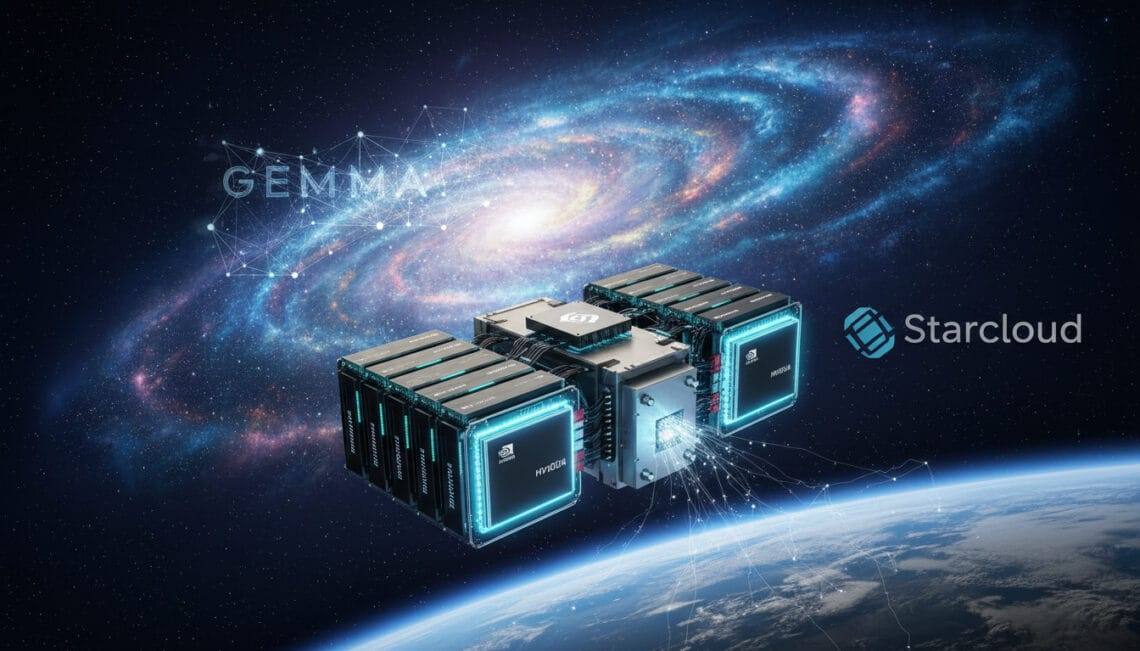
A Washington startup called Starcloud, backed by NVIDIA, launched a satellite last month carrying an H100 GPU. On December 10, 2025, the company announced it used that chip aboard Starcloud-1 to train Andrej Karpathy’s nano-GPT model on Shakespeare’s complete works and run inference on Google’s open Gemma model. Starcloud CTO Adi Oltean called it a “big first step toward moving almost all computing off Earth,” as reported in a PCMag article and CNBC.
The satellite even sent back a Gemma-generated message: “Greetings, Earthlings! Or, as I prefer to think of you—a fascinating collection of blue and green.” Starcloud founder Philip Johnston shared the news on LinkedIn, noting the H100 is 100 times more powerful than any previous space GPU, per OODA Loop and Proactive Investors.
Space Solves Earth Data Center Problems
Starcloud argues orbit beats Earth for AI compute. Satellites get constant sun-synchronous solar power and passive cooling from space’s vacuum—no water or fans needed. The company projects 10 times cheaper energy costs than ground setups, even after launch fees, and 10x less CO2 over a data center’s life versus Earth ones on traditional power.
Earth data centers face grid strain: the International Energy Agency expects their electricity use to double by 2030. Starcloud, an NVIDIA Inception member, Y Combinator alum, and Google Cloud AI Accelerator graduate, wants orbital setups to ease that, according to its Analytics India Magazine profile.
Future Builds and Challenges
Starcloud plans a 5-gigawatt orbital data center with 4km-wide solar panels—bigger output than the largest US power plant but smaller and cheaper than equivalent ground solar. Starcloud-2, with more GPUs, launches next year for customer access.
Cooling remains tricky in vacuum. Starcloud eyes air or liquid systems plus giant radiators. The single-H100 Starcloud-1 is fridge-sized; Earth clusters pack millions of GPUs.
Others in the Orbital Race
- Google’s Project Suncatcher tests satellite AI racks with tensor units and optical links; CEO Sundar Pichai eyes 2027 trials.
- SpaceX’s Elon Musk says Starlink V3 satellites will deliver 300-500 GW of solar AI compute yearly, beating US power use in intelligence every two years. SpaceX eyes a 2026 IPO for $25B+ to fund chips and centers.
- Jeff Bezos’ Blue Origin also pursues space data centers, with Bezos predicting operations in 20 years.
Starcloud’s feat proves the idea works, detailed in Office Chai.

Sebastyen
Sebastyen Wolf is our Editor-in-Chief. He is an analyst and entrepreneur with experience working alongside early-stage founders, launching online ventures, and studying the data patterns that shape successful companies. A fan of Shark Tank since Season 1, he now focuses on translating the show’s most valuable insights into clear, practical takeaways for readers.