
If You Actually Wanted Balance, You Wouldn’t Be Doing This
A follow-up to “No Work-Life Balance for Hybrid Entrepreneurs? My 2am Take On It….”, told in the same voice, with a harder look at behavior, identity, and the numbers behind both.
By Sebastyen | Opinion
If You Actually Wanted Balance, You Wouldn’t Be Doing This
A few nights after I wrote my 2:47 AM piece on hybrid entrepreneurship, I did the one thing tired people always do when they should go to bed. I opened another tab.
I ended up wandering through Inc. founder stories, productivity takes, money pieces, founder routines, all the familiar material that makes entrepreneurial life look sharp from a distance and chaotic up close. Freedom. Control. Optionality. Ownership. Build something of your own. Create your own rules. Escape the ceiling. Keep your upside. Those themes kept repeating. The language changed. The promise stayed the same.

Then a different thought hit me.
A lot of people say they want balance. Their calendar says otherwise. Their browser history says otherwise. Their spending says otherwise. Their late-night Stripe tabs, Figma files, prototypes, side projects, and domain purchases say otherwise. My own behavior said otherwise too.
That gap matters.
I say that as a scientist who wants data before philosophy. I also say it as a man who has stared at a laptop after midnight, trying to finish one more thing before the alarm clock makes fun of me again. If I only looked at my words, I would tell you I wanted more balance. If I looked at my actions, I would tell you I wanted autonomy, upside, control, and the strange satisfaction that comes from making something where nothing existed before.
That second version felt a lot closer to the truth.
The journals support it. The personality research supports it. The work on scientists who build companies supports it. The work on hybrid entrepreneurs supports it too. A hybrid entrepreneur does not stumble into a scheduling issue. A hybrid entrepreneur keeps voting, day after day, for a certain kind of life. That vote carries a price. It also reveals identity.
The data on who actually chooses the hybrid path
The first paper that framed this clearly for me was Joseph Raffiee and Jie Feng’s Academy of Management Journal study, “Should I Quit My Day Job?” They found that people who start as hybrid entrepreneurs and later jump into full-time self-employment show higher venture survival than people who leap directly from paid work into full-time entrepreneurship. That finding gave the hybrid route a clean strategic logic. Keep the paycheck. Test the idea. Learn while the cost of being wrong stays lower.
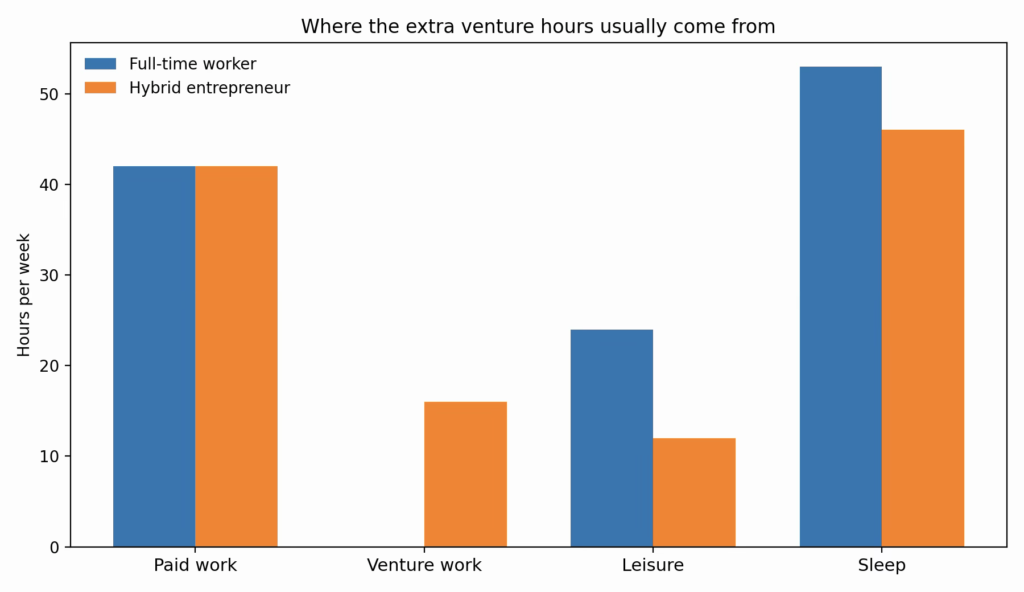
A hybrid schedule does not create extra hours. It reallocates them.
| Weekly use of time | Full-time worker | Hybrid entrepreneur |
| Paid work | 40-45 hours | 40-45 hours |
| Venture work | 0-2 hours | 10-25 hours |
| Leisure / downtime | 20-30 hours | 5-15 hours |
| Sleep | 49-56 hours | 35-49 hours |
A later review in the Technology Innovation Management Review added another useful point: hybrid entrepreneurs use salary income to absorb the liabilities of newness and smallness. That phrase sounds academic, but the translation is simple. Cash from the day job buys time. It also buys fewer desperate decisions.
That part sounds comforting, and it should. It explains why rational people with mortgages, kids, student debt, aging parents, pets, or ordinary adult responsibilities keep a foot in both worlds. The hybrid path lowers financial shock. It gives the venture a runway. It protects the family from a reckless jump.
Then the mood changes.
Retno Ardianti, Martin Obschonka, and Per Davidsson studied the psychological well-being of hybrid entrepreneurs in the Journal of Business Venturing Insights. Their findings drew a much less romantic picture. Hybrid entrepreneurs showed higher strain than both full-time employees and the full-time self-employed. They also reported lower job satisfaction than the full-time self-employed. You get the caution of employment and the pressure of entrepreneurship in the same week, sometimes in the same hour.
“Hybrid entrepreneurship looks rational on paper because it reduces downside. It feels irrational at 1:13 AM because the bill arrives in hours, attention, and sleep.”
That combination lands like a brick because it explains a feeling many hybrid entrepreneurs hide. You are not imagining the friction. The arrangement really does pull on the mind in two directions at once. One role wants competence, loyalty, and consistency. The other wants initiative, experimentation, and an appetite for uncertainty. One role pays you now. The other role whispers about a different future.
That strain does not stop people. It filters people.
If you truly wanted calm, your behavior would drift toward activities that protect calm. You would close the laptop. You would stop buying domains at 11:58 PM. You would stop reading SEO threads while your spouse watches television next to you. You would stop opening your notes app because a revenue idea arrived while you brushed your teeth. Many people do exactly that. No judgment there. It is a rational choice.
The hybrid entrepreneur keeps choosing differently.
The weekly math tells the story better than motivational language ever could.
Useful as a contrast point. His framework assumes more schedule control than most hybrid entrepreneurs actually have.
That table is not dramatic. It is just arithmetic. The full-time job rarely shrinks. The venture gets added on top. The hours usually come out of leisure first, then sleep, then recovery, then whatever time used to belong to family routines, exercise, reading for pleasure, or staring at a wall without a deadline attached to it.
No productivity influencer needs to explain this to a parent with a day job and a side business. The body explains it for you by Thursday.
What the time budget reveals
One of the cleanest ways to understand identity is to watch where time goes when nobody is grading you. Time works as a confession.
Entrepreneurship research has chased that question for years from different angles. Stephan and Roesler, writing in the Journal of Business Venturing, found that self-employment links to higher subjective vitality, meaningfulness at work, and autonomy. That does not mean entrepreneurship makes life easier. It means people often feel more alive inside work they own, even when that work carries risk and chaos.
That point matters because it explains why “balance” can lose repeated battles to projects that do not even pay yet. The activity is not competing only on money. It is competing on authorship. It is competing on identity. A venture lets a person make choices that feel self-directed. A normal job can offer purpose, challenge, and decent pay. It still places the final frame around your effort. You help build someone else’s machine.
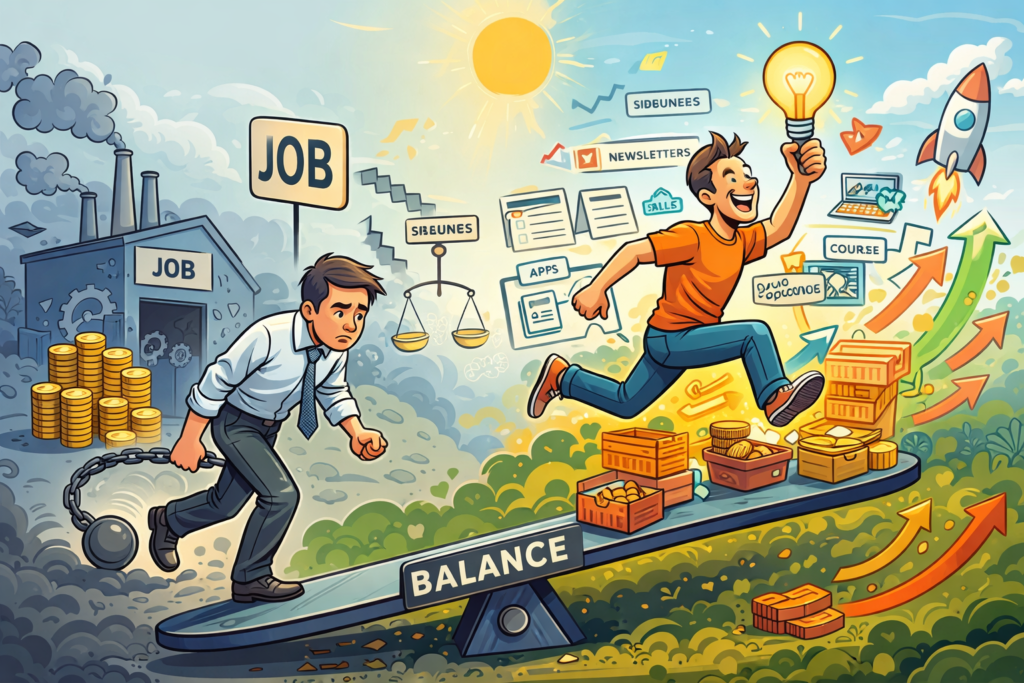
A side business, app, newsletter, service, product, SaaS, course, shop, or consulting offer changes the emotional equation. You choose the problem. You choose the pace. You choose the taste, the copy, the customer, the packaging, the price, the late nights, and the blame. That level of ownership scratches a very old human itch. Some people feel it lightly. Some feel it like static under the skin.
Scientists are supposed to love evidence more than myth, so let me say this plainly. The desire for autonomy does not sound noble in every form. Sometimes it shows up as vision. Sometimes it shows up as stubbornness. Sometimes it looks like creativity. Sometimes it looks like a control problem with better branding.
The data still points in the same direction. People who choose entrepreneurial work place high value on self-direction, responsibility for outcomes, and the chance to turn their own judgment into action. A meta-analysis by Hao Zhao and Scott Seibert found that entrepreneurs differ from managers on four of the Big Five traits: they tend to score higher on conscientiousness and openness to experience, and lower on neuroticism and agreeableness. That mix makes practical sense. Conscientiousness helps you keep going. Openness pushes you toward novelty and creation. Lower neuroticism helps you tolerate uncertainty. Lower agreeableness can make it easier to keep your own line when the world would prefer you stay convenient.
A later review in Personality and Individual Differences added an older but still useful cluster of entrepreneurial traits beyond the Big Five: generalized self-efficacy, stress tolerance, proactive personality, and need for autonomy. That last term sounds dry. In real life it looks like this: a person keeps reaching for a life where their choices matter more, where they can move without asking for permission every ten minutes, and where the ceiling above their output feels less fixed.
Scientists often call the entrepreneurial pull “curiosity” for a while. Then the behavior gets louder. You buy the domain. You sketch the interface. You start caring about users.
That person may still talk about balance. The behavior tells you the stronger motive.
A scientist’s version of the same conflict
This hit me harder once I read work on academic scientists. Scientists live inside a profession with its own code, status system, and definitions of success. Publish. Get grants. Produce rigorous work. Protect credibility. Stay careful. Earn respect by being right, not loud.
Entrepreneurship rewards a different mix. Speed helps. Selling helps. Risk helps. Timing helps. Taste helps. The market does not ask for a p-value. It asks whether anyone cares enough to pay attention or buy.
You would expect those identities to collide. Sometimes they do. The interesting part is that the collision does not always end in rejection.
Miao Wang and colleagues, writing in the Journal of Technology Transfer, found that entrepreneurial identity centrality in academic scientists positively influences the intention to engage in commercialization activities such as spin-off creation, patenting, licensing, and consulting. Even better, they found that scientific and entrepreneurial identity centrality can strengthen each other rather than destroy each other.
That finding should make a lot of scientists sit up straighter.
The old story says you must choose. Pure scientist or entrepreneur. Scholar or builder. Lab or market. Careful thinker or ambitious operator. The newer evidence gives a more accurate picture. Some people hold both identities and act from both. The tension stays real. The combination still works.
Christopher Hayter, Bruno Fischer, and Einar Rasmussen pushed that idea further in Small Business Economics. They studied how scientists develop an entrepreneurial identity and showed that identity growth often comes before entrepreneurial behavior. In plain English, people start acting like founders after they begin to see themselves as the kind of person who can build, translate, and commercialize ideas.
That sequence matters.
You do not wake up one morning as a founder because a Stripe notification goes off. You become entrepreneurial slowly. You start asking different questions. You begin caring about distribution, usability, positioning, business models, and adoption, not only technical soundness. You still care about the science. You also start caring whether the work reaches a human being outside the paper.
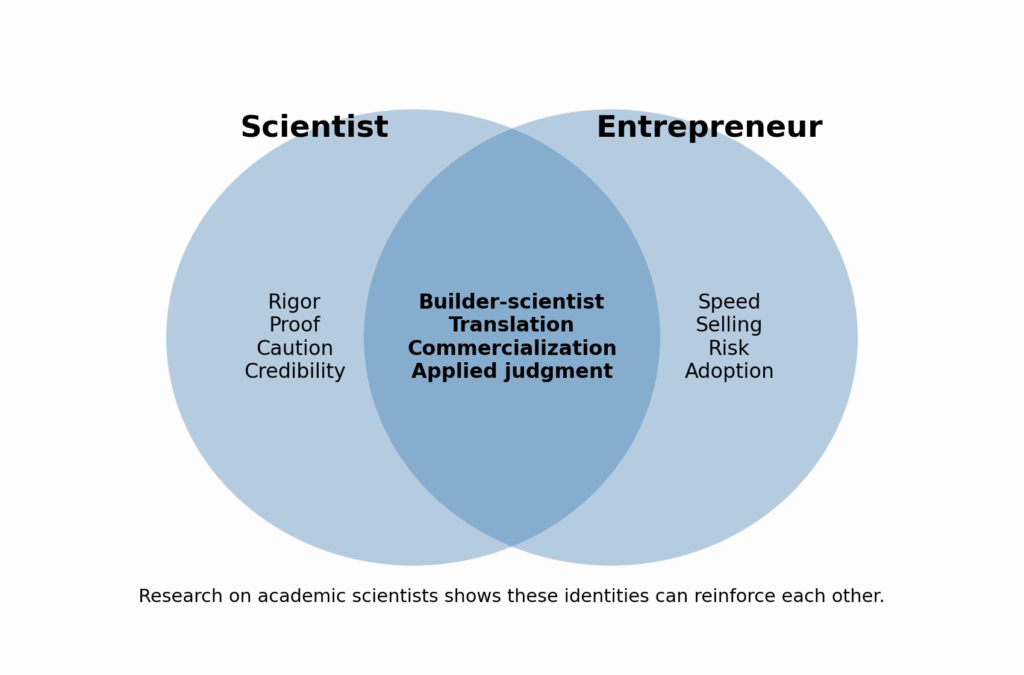
For many scientists, the tension sits between rigor and shipping. The overlap can become a career path.
| What gets traded | What you get back | What the hidden cost looks like |
| Evening downtime | More venture output | Shorter fuse, less mental slack |
| Sleep | Extra working hours | Worse judgment, weaker recovery |
| Comfort with certainty | A shot at asymmetrical upside | Chronic low-grade stress |
| Passive consumption | Authorship and creation | A brain that never fully clocks out |
That shift changes how you spend evenings.
Scientists often call the entrepreneurial pull “curiosity” for a while. Then the behavior gets louder. You buy the domain. You sketch the interface. You test a market. You start caring about users.
That is why hybrid entrepreneurship often feels so personal to scientists. The conflict is not just about time. It is about self-concept. One part of you respects caution. Another part wants to ship. One part wants rigor before movement. Another part wants contact with the real world before the tenth internal review. Neither side is foolish. They simply answer to different gods.
The personality layer nobody admits in public
People love broad entrepreneurial slogans because slogans save them from self-examination. “I want freedom.” “I want balance.” “I want to do meaningful work.” All nice sentences. All incomplete.
| “Your calendar is less interested in your stated values than in your repeated votes.” |
Personality research gives the conversation sharper edges.
The old fantasy says entrepreneurs are fearless extroverts with impossible confidence and a taste for chaos. The literature does not support that cartoon. The literature supports a more precise cluster. Entrepreneurs, on average, show higher openness and conscientiousness. They tolerate ambiguity better. They score higher on self-efficacy. They often show a stronger need for autonomy. None of that guarantees success. It does explain attraction.
That table explains a lot of midnight behavior. A person high in openness gets bored by pure repetition. A person high in conscientiousness keeps working after the novelty fades. A person with higher self-efficacy assumes effort might change the outcome. A person with stronger autonomy needs resists fixed constraints longer than other people do. Put those together inside a capable adult with internet access and a credit card, and you do not get balance. You get projects.
Now add ambition.
Useful for scientists who keep drifting toward applied work and want a practical lens on problem selection.
Ambition gets reduced too often to greed or ego, usually by people who either worship it or resent it. The data paints a broader picture. Ambition includes status for some people, money for others, and mastery for many. For a lot of hybrid entrepreneurs, ambition means refusing to leave all future upside inside a compensation band designed by someone else.
That motive does not sound poetic. It sounds practical.
- You can hear it in sentences like these:
- I want a shot at a different ceiling.
- I want to own what I build.
- I want my effort to compound somewhere I control.
- I want to see what I can do without the walls.
Those are identity statements disguised as work goals.
The ambition versus comfort trade
Comfort has marketing problems. People talk about it like a moral failure. It is not. Comfort protects health, relationships, sanity, and ordinary happiness. Comfort keeps marriages together. Comfort lets a parent show up rested at breakfast. Comfort gives people the mental slack to enjoy a weekend without turning every hobby into a funnel.
Ambition interrupts comfort. Frequently. Repeatedly. Sometimes stupidly.
The part people rarely say out loud is that many hybrid entrepreneurs know this and still choose the ambitious route. They do not always choose it because they hate comfort. They choose it because comfort stops being enough once they have seen an alternate version of themselves.
That is where the article title comes from.
If you truly wanted balance in the clean, symmetrical, protected sense of the word, you would not keep building under conditions that keep breaking balance. You would not keep volunteering for double accountability. You would not stay up measuring keyword volume, debugging workflows, drafting landing pages, or working on a beta while the rest of the house sleeps. You would not burn your best discretionary hours on uncertain upside.
You would choose another life.

Plenty of smart, admirable people do.
The hybrid entrepreneur keeps trading away a portion of comfort for the chance to become a different kind of person. That person may never arrive. The choice still reveals the desire.
Browsing Inc at night made that contradiction look almost funny. So many founder pieces celebrate freedom while skipping the invoice that freedom sends. Freedom asks for responsibility. Responsibility asks for stamina. Stamina asks for trade-offs. The trade-offs expose identity.
The trade-offs people hide
The public story usually sounds clean. “I’m working on something.” “I have a side project.” “I’m testing an idea.” Fine. Accurate enough.
The private version sounds rougher.
You are taking pieces from somewhere. Usually from yourself first. Sometimes from people you love.
The research on role demands makes that impossible to ignore. In Entrepreneurship Theory and Practice, Martin Obschonka and colleagues found that role demands outside entrepreneurship, such as rigid work hours and caring responsibilities, shape the well-being consequences of hybrid entrepreneurship. Caring demands hit hard. Rigid schedules hit hard. The arrangement becomes tougher when life already has non-negotiable weight.
That finding matters because it kills the fantasy that time management alone solves the problem. The same twenty-four hours do not feel the same to a single twenty-three-year-old with no dependents and to a forty-three-year-old scientist with a family, a job, a mortgage, and a venture.
A color-coded calendar cannot erase structural load.
This is the part of the article where fake inspiration usually shows up with a chirpy line about discipline. I have no interest in that. Discipline matters. Structure matters. Sleep matters. Systems matter. None of them erase trade-offs. They only help you choose them on purpose.
The useful question changes from “How do I get perfect balance?” to “What am I really buying with these sacrifices, and do I still want that purchase?”
That question sounds almost financial because it is. Hybrid entrepreneurship converts time, sleep, attention, and emotional energy into optionality. Optionality may become a real business. It may become a decent side income. It may become a failed experiment with educational value. It may become identity training for a future move you cannot see yet.
A lot of people want the reward without that exchange. They want autonomy as a feeling, not as a responsibility. They want upside without volatility. They want control without carrying the consequences. They want creation without long lonely stretches where nobody cares.
The market does not sell that package.
A better way to read your own behavior
This whole topic got more useful for me once I stopped using “balance” as a polite cover word for conflicting desires.
The better diagnostic sits in four questions.
- Do I keep choosing work that I direct myself?
- Do I care a little too much about owning the upside?
- Do I feel boxed in when other people control all major decisions?
- Do I get a strange amount of satisfaction from creating, even before the thing pays me?
A sustained “yes” across those questions tells you something important. You do not merely have a scheduling issue. You have an identity pattern.
That does not mean you should indulge every impulse. It means you should stop lying to yourself about what the impulse is.
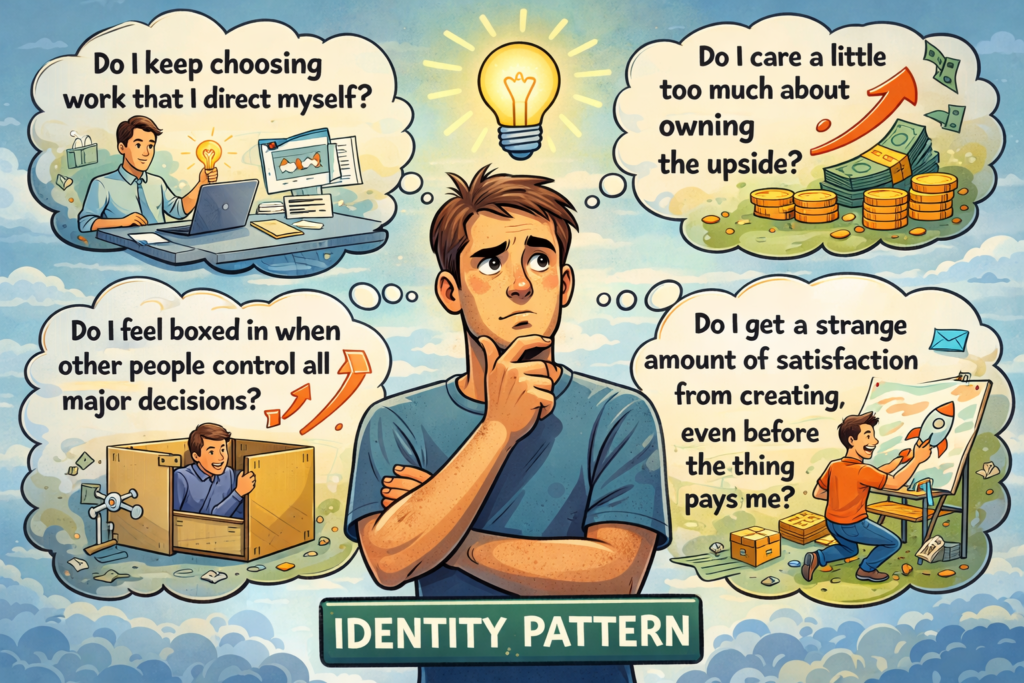
A hybrid entrepreneur who mislabels identity as poor scheduling will keep buying planners and feel guilty every Sunday night. A hybrid entrepreneur who sees the pattern clearly can design around it. Protect family blocks on purpose. Set hard shutoff times some nights. Choose one venture instead of five. Reduce context switching. Build in seasons. Decide what “enough” means before the market decides for you. That work starts from honesty, not hacks.
“Your calendar is less interested in your stated values than in your repeated votes.”
What success-minded people can apply without turning this into self-help soup
Data helps here because it forces precision.
The hybrid route works well as a testing ground. Raffiee and Feng’s survival finding supports that. The route also strains well-being. Ardianti and colleagues support that. Self-employment often raises autonomy and meaningfulness. Stephan and Roesler support that. Entrepreneurial identity drives behavior in scientists. Wang and Hayter support that. Personality patterns influence attraction to entrepreneurial work. Zhao and Seibert support that.
Put those pieces together and a clearer picture appears.
You improve your odds when you stop pretending that all high-achieving people want the same life. Some people want depth inside a stable role. Some want authority inside an institution. Some want financial security plus space for family and hobbies. Some want to build something with their own fingerprint on it badly enough to accept years of uneven sleep and psychological drag. None of those people need moral ranking. They need accurate self-knowledge.
For the person who recognizes the hybrid pattern in themselves, the practical lesson is not “work harder.” The lesson is “stop forcing yourself into a value system you do not actually live by.”
- If autonomy matters, build a life with a bigger autonomy allocation.
- If creation matters, protect time for creation before low-value maintenance work eats the week.
- If upside matters, admit that salary alone will keep feeling incomplete.
- If comfort matters more than you wanted to admit, accept that too and stop chasing founder theater.
The data does not command one answer. It clears the fog.
The part I had to learn as a scientist
Scientists receive years of training in how to distrust easy stories. That training helps. It also creates its own trap. You can overanalyze yourself into immobility. You can keep refining the model while somebody else launches version one.
A scientist with entrepreneurial pull often lives in that gap. You know enough to see the flaws. You do not always move fast enough to collect the evidence only action can produce.
That is why this topic felt personal.
The data did not tell me to glorify overwork. It did not tell me to become one of those online maniacs who treats sleep like weakness and family life like a branding inconvenience. It told me something more useful. My repeated behavior was not random failure at balance. It was evidence of a competing identity. Part scientist. Part entrepreneur. Part builder. Part tired idiot at midnight. Still moving.
Once I saw that clearly, I stopped treating the contradiction like a personal defect. I started treating it like a design problem built on honest inputs.
That shift lowered the guilt. It also increased the responsibility.
If I know I will keep choosing autonomy, upside, control, and creation, then I need to build guardrails around the cost. I need fewer fake commitments. Fewer extra projects. Fewer vanity tasks. Better sleep when I can get it. Better honesty about family trade-offs. Cleaner definitions of what progress even means.
That is a stricter standard than vague talk about balance. It asks for adult choices.
Final thoughts from the browser tab I should have closed
That late-night scroll through Inc did something useful for me. It reminded me how easy it is to confuse aspiration with identity. Plenty of articles tell people to seek freedom. Fewer ask whether they actually want the bill that comes with it. Plenty celebrate founders who reject comfort. Fewer ask how many people would feel happier with a life that protects comfort on purpose.
Hybrid entrepreneurship makes that question impossible to dodge because the proof keeps showing up in your own routine.
If you keep choosing to build after the day job ends, you are telling yourself the truth through action. You may still want more rest, more ease, and fewer frantic evenings. Of course you do. You are human. Still, the deeper vote keeps landing in the same place. You want authorship. You want room to move. You want a shot at a future you partly design. You want to make things. You want the possibility that your effort might compound on your own terms.
That desire has teeth. It also has a cost.
I respect the people who choose a calmer life and mean it. I respect the people who build after midnight and mean that too. Trouble starts when someone tries to live one life while talking like they want the other.
That mismatch burns energy. It breeds guilt. It confuses decisions that need clarity.
So here is the cleaner read, the one that survived after the journals, the late-night browsing, and the uncomfortable self-audit.
A lot of hybrid entrepreneurs do not have a balance problem. They have an identity they keep trying to negotiate down to something more socially acceptable. The calendar keeps refusing the compromise.
And that, for me, was the whole lesson.
I did not keep opening the laptop because I failed at balance.
I kept opening it because some part of me still wants to build.
That part may need more discipline. It may need better boundaries. It may need more sleep and fewer tabs. It does not need a fake story.
It needs the truth.
Sources appear inline as anchor text, matching the style of the reference article rather than being dumped into a bibliography.


You May Also Like