Hang Hero’s $851K Year Ended When They Fired Their Licensor. Then Daymond John Said Yes.
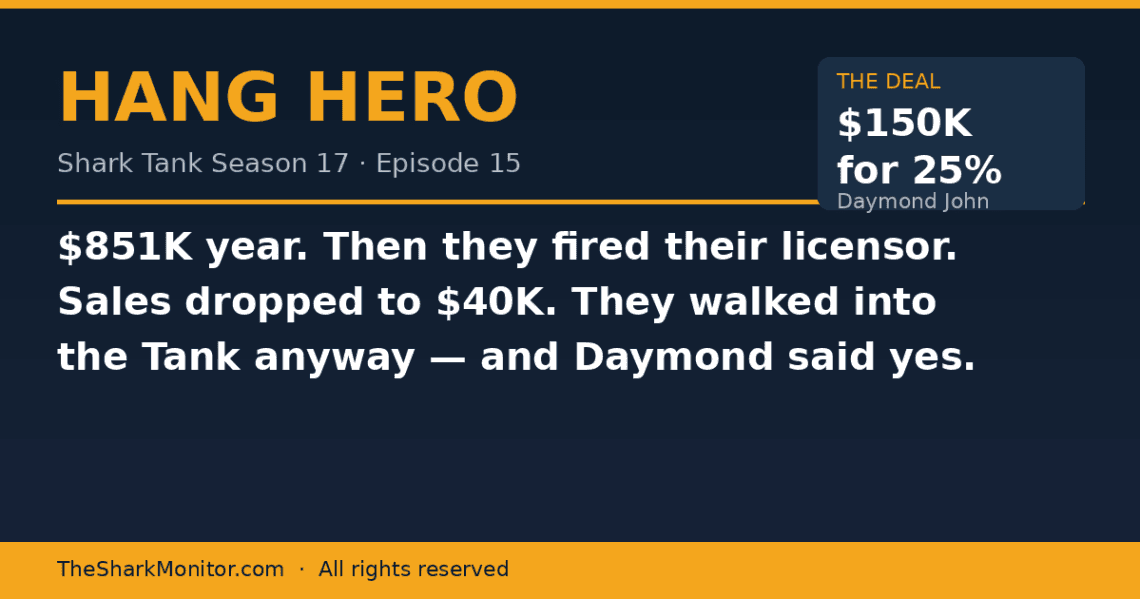
In 2024, Hang Hero was generating $851,000 in annual sales. By 2025, that number had fallen to $40,000. Michael and Ana Van Horst made that happen on purpose.
They had been running a licensing deal for years, manufacturing the Hang Hero picture hanging tool under a partner’s brand name — “Push & Hang by Level Art.” It paid $0.40 for every unit sold. The math was consistent enough. The shelves were stocked. The checks came in. But the product, at the end of the day, belonged to someone else’s brand. So they walked away from it.
They spent 2025 rebuilding from scratch, relaunching under their own name, eating the revenue hit, and taking their pitch directly to Daymond John on Season 17 of Shark Tank. It worked.
TL;DR
- Michael and Ana Van Horst founded Hang Hero in 2020 during the COVID-19 lockdowns
- The all-in-one picture hanging tool retails for $19.95 and comes with 50 brad nails
- Sales hit $851K in 2024 under a licensing arrangement, then dropped to $40K in 2025 after the founders reclaimed the brand
- They asked for $150,000 for 10% equity (a $1.5M valuation)
- Daymond John offered $150,000 for 25% equity and would not move below that
- The founders pushed for 20%; Daymond held firm; they shook at 25%
- Available at myhanghero.com, Amazon, Walmart, Walgreens, Lowe’s, QVC, and HSN
The Founders
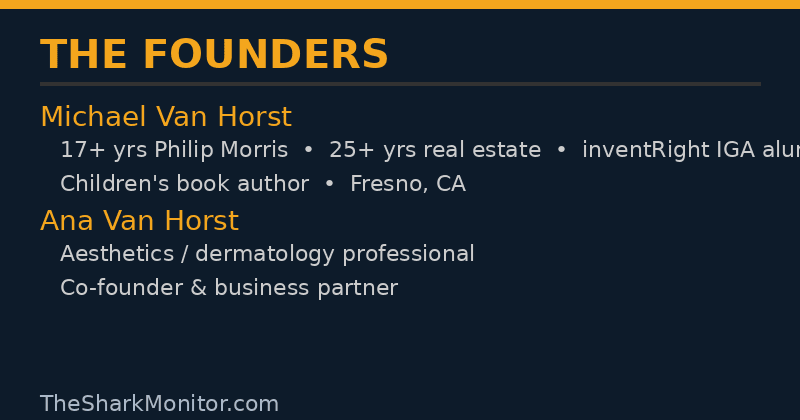
Michael Van Horst spent 17 years working for Philip Morris and another 25 years in real estate. Both careers gave him a version of the same education: how to work a system, how to talk to buyers, and how to know when a product either has legs or doesn’t. He’s based in Fresno, California, and he’s also a children’s book author — the kind of detail that makes more sense the more you learn about the pitch style he’d eventually bring to the Tank.
He’s also a graduate of inventRight, the product licensing school founded by Stephen Key and Andrew Krauss, and holds the IGA (Inventright Graduate and Alumni) designation. That matters because inventRight’s entire model is built around licensing products rather than manufacturing them — and the tension between licensing and ownership is the central story of Hang Hero.
Ana Van Horst works in the aesthetics and dermatology field. In interviews and pitch appearances, she comes across as the partner who keeps the tone grounded when Michael goes theatrical — which, by all accounts, he tends to do.
They built Hang Hero together during COVID, when home improvement projects were running at historic rates and the market for “I finally got around to hanging that art” was bigger than it had ever been.
The Product
Hang Hero is a picture hanging tool. The model number is HH-MC4, it retails for $19.95, and it does what its name says: helps you hang pictures without needing a tape measure, a pencil, a level, a drill, or a lot of patience.
The tool combines a level bubble, a built-in pencil guide, and a mechanism for placing brad nails exactly where they need to go. Each unit includes 50 brad nails. The max load is about 10 pounds per hang point, with a span of roughly three feet — enough for most standard-sized frames.
The typical frustration it replaces is this: you pull out a tape measure, try to find the center of a wall, mark it lightly in pencil, tap a nail in at what you think is the right height, hang the frame, step back, and realize it’s off by an inch and now leaning slightly to the left. You repeat this. Hang Hero is designed to compress all of those steps into one motion.
“A tool that actually does what it claims and doesn’t require a second person holding the frame” is about as high a bar as most people set for this category.
In March 2025, the Van Horsts added a second product: Pop & Hang, at $9.95. The positioning is simpler and more stripped-down, meant for frames that don’t need the full HH-MC4 treatment.
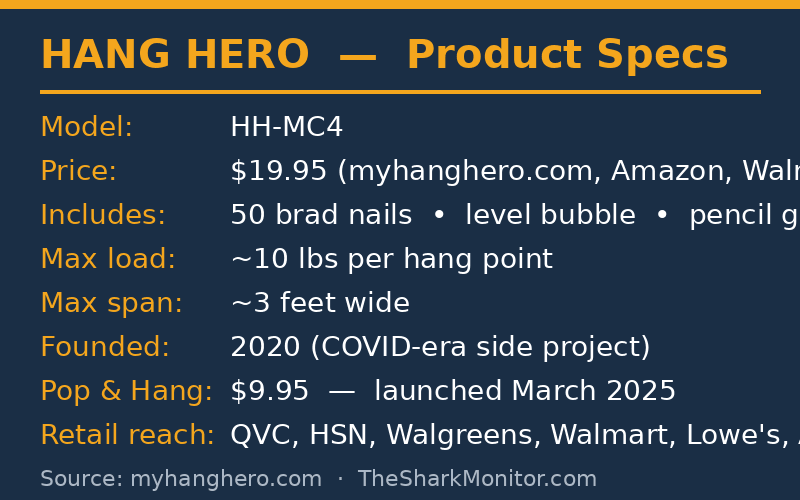
Retail distribution is broad for a product that had $40,000 in sales the year before Shark Tank. Hang Hero is available on myhanghero.com, Amazon, Walmart, Walgreens, Lowe’s, QVC, and HSN. The QVC and HSN placements are worth noting — those channels require a product that can be demonstrated live and create impulse purchases from home viewers. It’s one of the cleaner validations that the product demos well.
The Shark Tank Pitch — Season 17, Episode 15
Michael and Ana walked in with a $150,000 ask for 10% equity, implying a $1.5 million valuation. Before making their business case, they did a skit. Based on the episode coverage, Michael played up the comedy — the wrong holes, the crooked pictures, the husband-wife dynamic. The first demo attempt didn’t go as planned.
Kevin O’Leary awarded them the “bad theater award.” Lori Greiner countered with the “best picture award.” Neither one was wrong.
Kevin O’Leary, on the pitch’s dramatic opening: “That’s the bad theater award.”
Lori Greiner, on the demo: “I’m giving you the best picture award.”
Those two lines tell you something about how the room read the pitch: charming, a little chaotic, and competing with itself between entertainment and business substance. Michael is clearly a showman. The product worked when it worked. The skit either won people over or distracted them, depending on the Shark.
The valuation conversation was where it got real. At $1.5 million implied, the Sharks had to weigh that against $40,000 in 2025 sales — a number that demands explanation. The Van Horsts gave it one: the $851,000 in 2024 came from a licensing arrangement, they walked away from it to control their own brand, and they were effectively starting the clock again.
That’s a harder case to make in a room where the default reaction to a revenue drop that size is skepticism. But it’s also not without logic. A licensing deal at $0.40 per unit means you’re the manufacturer, not the brand. You don’t control pricing, shelf placement, or customer relationships. If the licensor walks, you have nothing. The Van Horsts decided that having something worth owning was better than having something that paid reliably but wasn’t theirs.
Daymond John was the one who wanted in.
The Deal Sheet
| Ask | $150,000 for 10% |
| Implied valuation | $1.5 million |
| Daymond’s offer | $150,000 for 25% |
| Implied valuation (deal) | $600,000 |
| Founders’ counter | $150,000 for 20% |
| Final deal | $150,000 for 25% (Daymond held) |
| Shark | Daymond John |
The Van Horsts pushed for 20%. Daymond didn’t move. He came in at 25% and stayed there. The gap between 20% and 25% represents a meaningful difference in ownership — at a $600,000 valuation, it’s $30,000 worth of equity — but Daymond’s position was strong: he was the only one making a real offer. You can hold out for better terms when you have options. They took 25%.
Daymond John, on the deal: “I’m at 25 and I’m staying there.”
The Numbers
The sales trajectory is the most unusual part of the Hang Hero story. Most Shark Tank pitches either show steady growth or a recent inflection point upward. Hang Hero’s chart goes up, then sharply down, with an explanation attached.
In 2020, the year Hang Hero launched, they did $240,000 in sales. That’s a strong first year for any consumer product. It suggests the demo worked, the price point was accessible, and early distribution was functioning.
By 2024, they had scaled to $851,000. The licensing deal with Level Art gave them the shelf space and the distribution that pushed revenue to that level. Under the “Push & Hang by Level Art” brand, the product was moving. At $0.40 per unit, you need to shift over 2 million units to generate $800,000 in royalties — which either means the $851K included manufacturing revenue too, or the volume was genuinely substantial.
Then they ended the deal in late 2024 or early 2025, relaunched as Hang Hero, and reported $40,000 in 2025 sales. That’s a starting-from-zero figure. New brand, new Amazon listing, new retail relationships to negotiate. It is exactly what you’d expect from a voluntary restart.
Whether the calculus pays off depends on what happens next. The Daymond deal — if it closes — connects them to someone who has built brands in consumer goods for decades. FUBU wasn’t just fashion; it was a distribution and marketing operation. If Daymond’s team treats Hang Hero as a real project, the access to retail buyers and the brand positioning advice alone could accelerate the recovery.
If the deal doesn’t close post-due diligence, the Van Horsts are still not in a bad position. They have a retail footprint that was built once and can be rebuilt. They have a product that demos well on live TV. They have the Shark Tank clip at https://thesharkmonitor.com/shark-tank-season-17-episode-15/ and the press that follows it.
Online Presence
Hang Hero’s home base is myhanghero.com, which runs on Shopify. The product listings are clean and the site pushes hard on the demo — video is central to how this product sells because it’s hard to explain in static images alone.
On Amazon, the listing carries the HH-MC4 model prominently and includes customer questions and answers that cover the most common objections: how heavy a frame it can hold, whether it leaves too many holes, and whether the included nails work with drywall. The review count before the Shark Tank airing was modest, which is normal for a brand that was essentially relaunched in early 2025.
The QVC and HSN placements give the product a live audience that has already opted into watching product demonstrations. That’s the ideal environment for Hang Hero. If a viewer watches a 90-second demo of someone hanging a frame in one try with no measuring tape, the barrier to impulse purchase is low.
The broader home improvement tool category on social media is dominated by DIY renovation content — which means Hang Hero has natural partners in the form of creators who film home makeovers, apartment upgrades, and gallery wall setups. That kind of content placement is cheaper than paid advertising and often converts better, because the context is organic.
What People Are Saying
Coverage of the Season 17 Episode 15 appearance focused primarily on the revenue story. The drop from $851K to $40K was the number that every recap highlighted, because it’s the kind of stat that demands context. The explanation — voluntary brand reclaim from a licensing arrangement — landed with different audiences differently. Some viewers read it as a bold bet. Others read it as a cautionary tale about the cost of chasing ownership.
The inventRight community, of which Michael is a recognized alum, tends to view licensing as a smart and underused strategy for inventors. The fact that a graduate of their program walked away from a licensing deal to go direct is somewhat ironic — and the Shark Tank framing put that tension on national television.
The episode aired March 25, 2026, and the Daymond deal was the one that closed the room in Episode 15, which also featured Hele Outdoors, Everything Blocks!, R1SE, and a widely noted return appearance from Mark Cuban.
Hang Hero’s pitch was memorable for the comedy and for the unusually honest sales narrative. Michael and Ana didn’t try to hide the 2025 number. They explained it, owned it, and made the case for why the short-term pain was worth it. That’s a harder pitch to make than “we’re growing 30% year over year.” Whether the Sharks found it compelling enough depended on which one was listening.
Only Daymond was listening closely enough to write a check.
Final Take
Hang Hero is a product that works. The demo is the business case. Anyone who has tried to hang a gallery wall with a tape measure and two pencils knows the problem is real, and the $19.95 price point is low enough that the solution doesn’t need a lot of convincing.
The business story is more complicated. Trading $851K in consistent revenue for $40K in uncertain revenue is not a standard playbook move. The Van Horsts clearly believe Hang Hero has more value as a standalone brand than it ever did as a licensed product under someone else’s name. That might be right. It also might be a decision they’re still paying for.
Daymond John at 25% is a meaningful partner for what they need right now. The brand has to rebuild retail relationships, establish Amazon reviews, and find its voice on social media. Those are all things Daymond’s orbit can accelerate if the deal closes and both sides stay engaged.
The inventRight training Michael brought to this process is visible in how the product was conceived — identify a problem, build something specific, keep it simple enough to demonstrate in 90 seconds. The part inventRight doesn’t teach is what comes after licensing: building your own distribution, managing retail accounts, running ads, and doing the slower work of customer acquisition that doesn’t come with a partner’s shelf space attached.
That’s what 2025 was. That’s what Hang Hero is now trying to turn into a growth story.
The drama of the pitch, the bad theater award, the skit that went sideways in the first attempt — all of it was real. But underneath the showmanship was a couple who made a calculated, expensive choice to own something they built, and who were willing to take $150,000 at a $600,000 valuation to prove it was worth owning.
Daymond said yes. Now comes the actual work.

Sebastyen
Sebastyen Wolf is our Editor-in-Chief. He is an analyst and entrepreneur with experience working alongside early-stage founders, launching online ventures, and studying the data patterns that shape successful companies. A fan of Shark Tank since Season 1, he now focuses on translating the show’s most valuable insights into clear, practical takeaways for readers.