Hele Outdoors — Shark Tank Season 17 Episode 15
<\!-- wp:html -->
<\!-- /wp:html -->
Murray White finished his first working prototype on a Friday. The following Monday, he got laid off.
He had spent months building a car camping platform out of his garage in Colorado, trying to solve a problem he had run into himself: he wanted to sleep comfortably in the back of his SUV without hauling a disorganized pile of gear that took an hour to sort every time he set up camp. When the prototype worked, he showed it to some people. The feedback was strong. Then his job at a tech company evaporated.
He used his severance to launch Hele Outdoors instead. That was September 2023. By March 2026, he was standing in front of five investors on national television with nearly half a million dollars in sales and a deal to chase.
TL;DR
- Murray White founded Hele Outdoors in September 2023 after getting laid off from tech sales
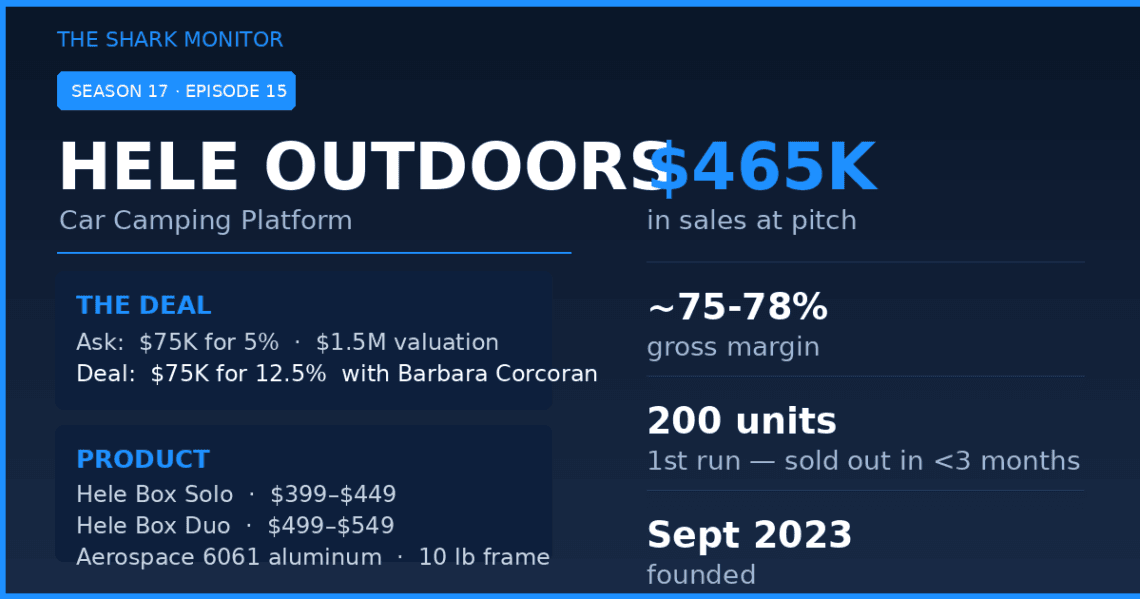
- The Hele Box is a modular aluminum sleeping platform for SUVs and pickups — Solo ($399–$449) and Duo ($499–$549) models
- First production run of 200 units sold out in under three months
- ~$465,000 in sales heading into the pitch
- Murray asked for $75,000 for 5% equity ($1.5M valuation)
- Barbara Corcoran opened at $75,000 for 20%; Murray countered at 12.5%; she took it
- Daymond John also made an offer before Barbara’s deal closed
- 3% of profits go to nature conservation in Hawaii and on the mainland
- Available at heleoutdoors.com; @heleoutdoor has 33K followers
The Founder
Murray White grew up on the North Shore of Oʻahu. Surfing, fishing, camping — the outdoors were not a hobby, they were the context he grew up in. When he moved to Colorado, the mountains gave him a different version of the same thing: somewhere to disappear into on weekends.
He built a sales career that took him through GNC, WalkMe, DocuSign, and Outreach, working his way from SDR to commercial account executive between 2016 and 2023. Tech sales runs on structured persistence — you build a pipeline, you manage objections, you learn to read a room quickly and know when to push and when to wait. That training would show up later in a different kind of room.
He holds a bachelor’s in business administration from the University of San Francisco. And after five years in software sales, he understood one thing about product-market fit better than most first-time founders: the customer’s frustration has to be real, specific, and common — not just something you imagined bothered other people because it bothered you.
His frustration with car camping was real. He had tried the existing options — foam pads, inflatable mattresses jammed awkwardly over folded-down seats, sleeping bags on top of uneven cargo. Nothing was actually designed around the inside dimensions of an SUV in a way that was both comfortable and organized. He wanted a flat, stable platform with storage underneath, something lightweight enough to pull out and set up without needing a second person or a tool kit.
He built one. It worked. He got laid off. He decided to stop waiting for permission.
“I couldn’t find anything that actually solved the problem, so I built it myself — and the second I tested the prototype, I knew I had to go all in.” — Murray White
The Product
The Hele Box is a modular aluminum sleeping platform designed to convert the back of an SUV, crossover, or pickup truck into a flat bed with organized storage underneath. The frame is aerospace-grade 6061 aluminum — the same alloy used in bicycle frames and aircraft components — which puts the total frame weight at just under 10 pounds. The full system, including mattress, comes in at around 25 pounds.
It comes in two versions: the Solo, designed for one person, and the Duo, built for two. Adjustable legs handle uneven terrain without shimming or improvising. Slide-out compartments under the platform keep gear accessible without having to move the sleeping surface. Assembly is tool-free — the frame clicks together in the field.
The mattress is a hybrid inflatable designed to be firmer or softer depending on preference, with a sleeping surface that sits flat over the cargo area rather than sloping with the contour of the seats. The practical difference is significant: sleeping on a slope is something campers tolerate, not something they choose. A properly flat surface with a decent mattress is a different experience entirely.
The Solo retails between $399 and $449. The Duo runs $499 to $549. Manufacturing costs are $105 and $117, respectively — margins that sit comfortably in a range that makes the business model workable even at modest volume.
One distinction Murray has leaned into is that the Hele Box functions as more than a sleeping platform. The frame can be removed from the vehicle and used as a camp table, which turns it into a piece of gear that earns its space even when you’re not sleeping in the car. That kind of dual-use design tends to reduce purchase hesitation for buyers who are already calculating how much weight they’re willing to add.
The Hele Box is one of the cleaner executions of the car camping platform concept we’ve tested. The 6061 frame is rigid without being heavy, the storage access works, and the tool-free setup genuinely takes under ten minutes. — GearJunkie
<!– wp:embed {“url”:”https://www.youtube.com/watch?v=MKLjQdGDHvw”,”type”:”video”,”providerNameSlug”:”youtube”,”responsive”:true,”className”:”wp-embed-aspect-16-9 wp-has-aspect-ratio”} –>
<!– /wp:embed –>
The Shark Tank Pitch — Season 17, Episode 15
Murray walked onto Season 17, Episode 15 asking for $75,000 for 5% equity — a $1.5 million valuation on a company that had been in business for about two and a half years. He brought the Hele Box with him and demonstrated the assembly on stage.
The pitch hit on the car camping category’s numbers. According to the Outdoor Industry Association, car camping and overlanding have been among the fastest-growing segments of outdoor recreation since 2020. The pandemic pushed a lot of people into car-based outdoor trips who would not have considered them before, and a meaningful portion of that group kept going once restrictions lifted. Murray had timing on his side: he launched into a market that had just received an involuntary upgrade in awareness.
The Sharks tested the product. The setup demonstration landed. And then the deal conversation started.
Kevin O’Leary stepped out. Lori Greiner stepped out. Rashaun Williams stepped out. The math wasn’t persuasive enough for them — $75,000 for 5% requires confidence in growth that $465,000 in lifetime sales doesn’t necessarily prove at a $1.5 million valuation.
Daymond John made an offer. Barbara Corcoran made one too. Barbara went in at $75,000 for 20%, which valued the company at $375,000 — more than four times below Murray’s opening ask. Daymond’s position gave Murray leverage. He pushed back, countered at 12.5%, and Barbara smiled.
She took it.
Barbara Corcoran, on closing the deal: “I already know what this market can do — I’ve watched a camper van company turn into a $15 million business. I see the same potential here.”
The deal — $75,000 for 12.5% — values Hele Outdoors at $600,000. That’s 60 cents on the dollar compared to Murray’s ask. But a Barbara Corcoran co-sign and the national exposure from a Shark Tank episode are not nothing, especially in a category where the barrier to awareness is high and the cost of customer acquisition is steep.
The Deal Sheet
| Ask | $75,000 for 5% |
| Implied valuation (ask) | $1.5 million |
| Barbara’s offer | $75,000 for 20% |
| Murray’s counter | $75,000 for 12.5% |
| Final deal | $75,000 for 12.5% |
| Implied valuation (deal) | $600,000 |
| Shark | Barbara Corcoran |
The negotiation worked in Murray’s favor. Barbara opened at 20%, which was aggressive, and he got her down to 12.5% without losing her. That 7.5-point swing matters: at a $600,000 valuation, it’s $45,000 worth of equity. The fact that Daymond John was also on the table gave Murray enough standing to push rather than accept on the first offer.
Barbara’s prior experience in the space — she referenced a camper van company in her portfolio that had grown to $15 million — gave her conviction on the category. That’s the kind of thesis-based investment that tends to lead to more active involvement post-deal: she already believes in the macro, she just needed to believe in the product and the founder.
The Numbers
Hele Outdoors launched in September 2023 with a 200-unit first production run. All 200 sold out in under three months. That’s a clean proof of concept: a founder with no manufacturing background, no retail relationships, and no prior brand equity moved 200 units of a $400–$550 product before the calendar turned.
The sales figure going into the pitch was approximately $465,000. The company had been operating for roughly 30 months at that point. That comes out to about $186,000 per year on average — but the trajectory matters more than the average. A sellout first run followed by growing repeat demand and press coverage from GearJunkie and Outside Magazine is a different picture than flat sales spread across 30 months.
Manufacturing costs are $105 for the Solo and $117 for the Duo. At the midpoint retail prices — $424 for Solo, $524 for Duo — the gross margin is roughly 75% on Solo and 78% on Duo. For a physical goods business, those numbers are unusually good. Most consumer hardware products aim for 50% gross margin and live at 40%. The Hele Box has room.
The funding, if the Barbara deal closes post-due diligence, is earmarked for manufacturing capacity and marketing. A $75,000 injection is not scale capital in any traditional sense, but it’s enough to meaningfully expand production volume and run paid acquisition campaigns that the company couldn’t fund out of sales alone at this stage.
Online Presence
Hele Outdoors operates out of heleoutdoors.com, a Shopify-based storefront. The site is built around the product demonstration — video content showing the platform being installed, the sleep surface compared to alternatives, and the under-platform storage in use. That’s the right call for a product where the value proposition is hard to communicate in static product shots.
Instagram is at @heleoutdoor with 33,000 followers across 193 posts. The account mixes product demonstrations with user-submitted content from campers who have taken the Hele Box into the field. At $400–$550 per unit, user-generated content does heavy lifting: a photo of someone’s truck set up for a weekend trip in the Rocky Mountains or the Cascades is more persuasive than a studio render.
The outdoor and overlanding communities on social media are organized and vocal. There are dedicated Reddit forums, YouTube channels, and Instagram accounts for car camping, SUV builds, and overlanding rigs. Getting into those communities — not as an advertiser but as a product people actually use and talk about — is the fastest path to credible growth for a brand in this space.
Murray’s own background working in tech sales at Outreach and DocuSign, both companies that depend on structured outbound and content marketing, gives him a better-than-average starting position on organic growth. He understands the funnel.
<!– wp:embed {“url”:”https://www.youtube.com/watch?v=mzNXjSsUl2A”,”type”:”video”,”providerNameSlug”:”youtube”,”responsive”:true,”className”:”wp-embed-aspect-16-9 wp-has-aspect-ratio”} –>
<!– /wp:embed –>
The company’s environmental commitment — 3% of profits to nature conservation in Hawaii and on the mainland, with annual donations made every January — is worth noting because it’s specific and verifiable. Brands in the outdoor space often gesture at conservation without putting a number on it. “3% of profits, named beneficiary organizations, annually verified” is a different thing than a values statement on the About page.
What People Are Saying
GearJunkie tested the Hele Box and came away positive. Their review highlighted the frame construction, the tool-free assembly, and the practical utility of the storage system. In outdoor gear coverage, GearJunkie sits near the top of the credibility stack — they test products in real conditions and their readership is experienced enough to know the difference between a product that works and one that looks good on a spec sheet.
Outside Magazine covered the product through writer Graham Averill, adding another layer of mainstream outdoor press validation. That kind of editorial placement, outside of paid promotion, is the type of third-party endorsement that moves actual buyers.
The Season 17 Episode 15 recap at The Shark Monitor covers the full episode, including Hang Hero, Everything Blocks!, and R1SE alongside Hele Outdoors.
The car camping category has a few competing products — foldable cots, inflatable platforms, van conversion kits — but there’s no dominant brand in the SUV-specific sleeping platform segment. The closest analogs are either too heavy, require professional installation, or are designed for dedicated overlanding rigs rather than everyday SUVs that also need to function as family vehicles on weekdays. Hele’s pitch is that it fits in either context.
Post-episode feedback from viewers focused on three things: the price point (reasonable to some, steep to others), the fit compatibility across different vehicle models, and the founder’s story. The laid-off tech worker who bet his severance on a camping product and grew it to $465,000 in two and a half years is a narrative that lands well with Shark Tank’s audience.
The Hele Box earned its price point. For anyone who has tried to make a standard air mattress work in an SUV — fighting the uneven surface, the gear sprawl, the morning contortion to find your keys — this is the product you wanted to exist.
Final Take
The Hele Box solves a real problem for a large and growing audience. Car camping isn’t a fringe activity. Tens of millions of Americans sleep in their vehicles each year, and the number went up significantly after 2020 and hasn’t come back down. A lightweight, well-engineered sleeping platform that sets up without tools and keeps gear organized is something the market was clearly waiting for — the first-run sellout proved it before Murray had a marketing budget or a press feature.
The business math is solid. Gross margins in the 75–78% range on physical goods at this price point are unusual and durable. The Hele Box doesn’t need to move at massive volume to be profitable. It needs distribution and awareness, which is exactly what Barbara Corcoran’s network and the Shark Tank episode itself provide.
The $600,000 valuation is conservative. Murray came in at $1.5 million and ended at $600,000, which stings. But the deal with Barbara gives him something more valuable than a validation of his asking price — it gives him a partner who has already watched a vehicle-based outdoor company grow into a $15 million business and who made this investment because she sees the same trajectory. That’s not a reluctant deal. That’s a thesis bet.
The things that have to go right from here: the Barbara deal needs to close post-due diligence (they don’t always), the company needs to handle the traffic spike that follows a Shark Tank airing without stockouts or fulfillment failures, and Murray needs to build out the distribution infrastructure beyond direct-to-consumer before the episode buzz fades.
None of that is out of reach for a founder who turned a layoff into a $465,000 outdoor brand in under three years. He made the prototype work. He made the pitch work. The next phase is harder but the foundation is real.
Murray White grew up on the North Shore of Oʻahu, surrounded by people who treated the ocean as something to be in, not looked at. He built a company around the same instinct: the outdoors are for using, and the gear that gets you there should actually work.
The Sharks who passed may want to watch this one.
<\!-- wp:separator {"className":"is-style-wide"} -->
<\!-- /wp:separator -->
<\!-- wp:group {"className":"tsm-author-bio"} -->
<\!-- /wp:group -->

Sebastyen
Sebastyen Wolf is our Editor-in-Chief. He is an analyst and entrepreneur with experience working alongside early-stage founders, launching online ventures, and studying the data patterns that shape successful companies. A fan of Shark Tank since Season 1, he now focuses on translating the show’s most valuable insights into clear, practical takeaways for readers.