The Qi Turned a Cup of Whole Flowers into $2.9 Million — Then Daymond Took Notice
TL;DR:
- Lisa Li built The Qi around a single concept: one whole dried flower, one cup, nothing else
- Walked into Shark Tank Season 17 asking $200,000 for 8% equity
- Four Sharks passed; Daymond John closed at $200,000 for 20%
- $2.9 million in lifetime sales, 80% gross margins, and $616,000 in 2024 revenue
There is a moment during The Qi’s Shark Tank pitch that stops everything. Lisa Li drops a dried blue lotus flower into a cup of hot water and the petals slowly unfurl, releasing a tea that looks like a small lake at dusk. Then someone pours honey in, and the tea turns purple. Robert Herjavec’s reaction was immediate. So was everyone else’s.
That’s the product — not a bag, not a blend, not a powder. A single dried flower. Drop it in hot water, watch it bloom, drink it. The Qi sells this as a ritual, not just a beverage, and that framing is either its greatest asset or its biggest commercial liability, depending on who you ask.
The answer shapes everything: the valuation fight with the Sharks, the business model, the path to scaling. It’s not a simple story.

The Founder
Lisa Li grew up in Beijing, where tea was woven into ordinary life. Her grandmother drank it daily, and that ritual stayed with her even after she moved to the United States and spent a decade in the fashion industry. But by her own account, those years ground her down. She was burned out, stressed, and eventually diagnosed with a thyroid condition that conventional medicine struggled to address. She turned to acupuncture and herbal remedies instead.
In 2017, Li and her mother traveled to Shangri-La in China’s Yunnan Province — a region known for its biodiversity and traditional herbal culture. At a small teahouse, a server didn’t bring her tea bags or loose leaf. They brought a whole rose. One flower. One cup. The petals bloomed in the hot water and the experience stuck with her.
She came back to New York and spent the next stretch of time sourcing, testing, failing, and starting over. She tasted more than a hundred different herbs. She visited small family farms across Asia and looked for growers who would hand-pick flowers without artificial additives or preservatives and who had the patience for that kind of careful, low-volume harvesting. The Qi launched out of that process.
The brand is headquartered in New York City, with a studio at 27 West 20th Street that doubles as a space for workshops and community tea rituals. Strip everything away and you have a one-person vision that became a real business before it ever got anywhere near a TV studio.
The Product
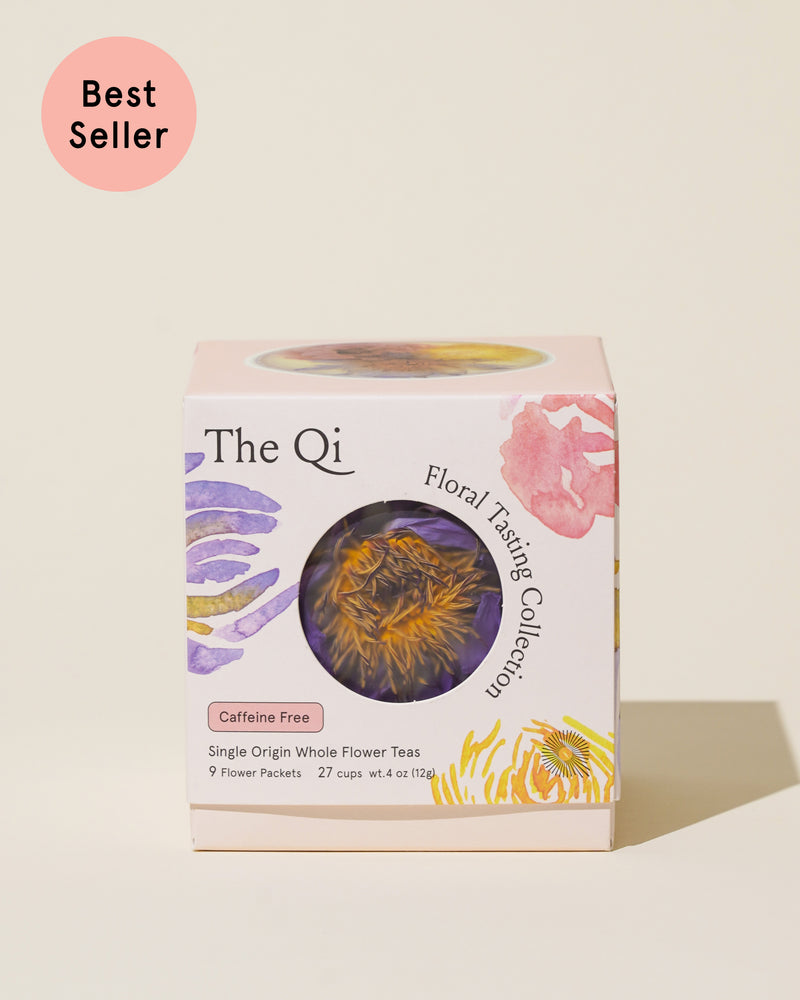
The Qi doesn’t sell tea the way most tea companies sell tea. No bags, no blends, no leaves, no caffeine. Each product is a single dried whole flower. You drop it in hot water, and it blooms again — petal by petal — as you watch.
The flagship products are Shangri-La Rose, Blue Lotus, and Royal Chrysanthemum. Each is sourced from small family farms across Asia, handpicked and dried to preserve the flower’s integrity. One flower yields three cups: steep, refill, refill. That structure matters for the math. At $36 for a box of nine flowers, each cup costs roughly a dollar and thirty cents. It’s priced as a premium product, and the margins reflect that — 80% gross, with a $7 landed cost on a $36 retail price.
The business runs across three channels: direct-to-consumer through the-qi.com, wholesale, and hospitality placements in spas. The Qi has also sold through Amazon, expanding its reach beyond its DTC base. After the Shark Tank episode aired in November 2025, the brand launched themed bundles timed to the post-show traffic spike — a smart move for a small operation trying to convert a one-night audience into repeat buyers.
The product also carries a strong visual identity. A blooming flower in a glass cup photographs well, and the color-change reaction of the Blue Lotus — which shifts from blue to purple when honey is added — is the kind of content that does most of its own marketing.

The Shark Tank Pitch
Lisa Li walked into Season 17, Episode 5 of Shark Tank on November 5, 2025, asking for $200,000 in exchange for 8% equity — a valuation of $2.5 million.
The pitch landed well on a sensory level. The flowers bloomed in front of the Sharks, the tea changed color with honey, and Daymond John later called it one of the most beautiful pitches he had seen. The numbers Li presented were strong for a business at this stage: $2.9 million in lifetime sales, $616,000 in 2024, and a projection to cross $1 million in 2025. Margins of 80% are rare in food and beverage. The business model had real structure.
But the Sharks had questions about the category itself. Lori Greiner went out. Kevin O’Leary said the space was too competitive and followed. Robert Herjavec didn’t see a clear path to scaling the model and stepped back as well. Allison Ellsworth — making her debut as a guest Shark on this episode — admired the packaging but felt the category wasn’t defined well enough for retail.
That left Daymond John. He offered $200,000 for 25%. Li countered at 18%. They landed at 20%.
| Ask | $200,000 for 8% |
| Deal | $200,000 for 20% |
| Shark(s) | Daymond John |
| Valuation asked | $2.5 million |
| Valuation implied by deal | $1 million |
The valuation haircut is significant. Li walked in at $2.5 million and walked out at $1 million implied — a 60% reduction on paper. Whether that’s the right trade depends entirely on what Daymond actually brings to the distribution relationship. His background in fashion and consumer brands is relevant; his knowledge of the wellness tea space in particular is less obvious. The deal has not been publicly confirmed as closed as of this writing, which is standard for Shark Tank — due diligence can take months after filming.
“You are not just selling tea — you’re selling your ritual. That’s the reason people feel connected.” — Daymond John
Business Insights & Highlights
The numbers Li presented on Shark Tank were strong, and they expose the central tension in The Qi’s story. $616,000 in annual revenue with 80% margins translates to roughly $493,000 in gross profit for 2024 — enough to sustain a bootstrapped DTC brand, but not enough to suggest explosive growth ahead. The lifetime figure of $2.9 million across six-plus years of operation shows staying power. This is not a company that launched in 2023 and rode a single viral moment.
The problem is scale. Whole flower tea at $36 per box appeals to a specific buyer — someone treating the brew as a ten-minute ritual rather than a caffeine delivery mechanism. That niche is real and profitable, but competing in mainstream retail against Harney & Sons, Numi, and traditional Chinese tea companies (where the game is played on volume and price) is a different category entirely. The Sharks who exited weren’t wrong to wonder whether The Qi’s ritual-first positioning can survive that transition.
Did You Know? The Qi’s Blue Lotus tea changes color when honey is added — shifting from pale blue to deep purple. That single visual moment has been one of the brand’s most-shared pieces of content, and it costs nothing to produce. The product markets itself.
The hospitality channel — spas, wellness centers, upscale hotels — is actually the more compelling growth path here. The product fits that setting naturally. A spa offering a $15 flower tea experience as a treatment add-on makes far more sense than a Target aisle placement next to Lipton. If Daymond can open those doors, the deal is worth the valuation concession.
Prior to Shark Tank, The Qi operated without outside funding and got there on its own — DTC sales, careful wholesale placements, and press coverage with outsized reach for a bootstrapped company. Features in Thrillist, Food & Wine, and Martha Stewart are the kind of earned media that small brands rarely land without a PR budget. The New York Times has covered the brand as well. That visibility helped sustain $2.9 million in lifetime sales without any formal funding round.
The post-Shark Tank traffic spike was real, and the company moved quickly to capitalize — the themed bundles on the website were up fast. That kind of operational responsiveness matters when you get a single night of national television exposure. Brands that miss that window often regret it.
The main risk to the model is concentration. If the business leans heavily on DTC and a small number of wholesale accounts, any disruption — a change in Amazon’s algorithm, a sourcing issue with one farm, a slow season — hits harder than it would for a more diversified operation. Whole flowers also require careful handling and storage, and scaling that supply chain while maintaining the handpicked, small-farm sourcing story is genuinely challenging in ways that most beverage businesses never have to confront.
Online Presence & Community
The Qi’s Instagram account, @drinktheqi, has 53,000 followers. That’s a meaningful number for a small wellness brand without paid media, and the account earns it — the visual content does exactly what it should. A flower opening slowly in a glass of hot water is a short video that practically makes itself, and Li has built a feed where the product does most of the convincing before anyone clicks a link.
Lisa Li also maintains a personal account, @thebetterlisa, with around 2,095 followers — a smaller audience, but not a secondary vanity project. It’s where the brand’s origin story lives in full: the years in fashion, the thyroid diagnosis, the teahouse in Yunnan. That storytelling is what converts casual browsers into buyers who pay $36 for a flower. The combination works precisely because both accounts are active and consistent.
The content strategy is coherent across the board: show the flowers, show the ritual, show what happens when the flower opens. For a product where the act of brewing is half the value proposition, that’s the only approach that makes sense. Following the Shark Tank episode, the brand’s following grew and the conversation picked up noticeably — momentum the company reinforced with the post-show bundle launch.
What People Are Saying
Customer feedback on The Qi splits into two clear camps — and the split is revealing.
The buyers who understand what they’re getting — a ritual, a moment, something to watch — tend to write reviews that read like small essays. They describe watching the flower bloom as surprisingly grounding. They note that the flowers stay whole and intact, unlike crushed flower teas that arrive stale and formless.
“Watching the flower slowly release and bloom in water is a surprisingly calming and delightfully joyful experience.” — Verified Amazon Customer
The Blue Lotus draws the strongest reactions, partly because of the color-change trick with honey. The buyers who expected a strong-flavored cup of tea are less satisfied. The taste is real but subtle — this is a whole flower steeped simply, not a concentrated extract. One reviewer described the flavor as “not particularly exceptional, but nice and subtle,” adding that it was better for a special ritual than a cozy everyday cup. That’s honest, and it’s a useful framing for thinking about who this product is actually for.
Some reviewers complained about price relative to portion, and a handful mentioned inconsistent customer service. For a small DTC operation without a large support team, these are known growing pains.
The press coverage has been consistently positive. Food & Wine, Thrillist, Martha Stewart, and the New York Times have all featured the brand. These are not trade publications that cover wellness trends — they’re mainstream outlets, and that placement reflects real editorial interest in the product and the founder’s story. The fashion-to-wellness arc, the thyroid diagnosis, the trip to Yunnan, the grandmother — it’s a story that journalists want to tell. Li tells it well.
The pitch didn’t spark Reddit Shark Tank debates, which tells you something: there was no controversy to argue about. The Sharks who went out had legitimate concerns about category ceiling, not character flaws in the founder or integrity issues with the product.
Final Take
The Qi is a real business with a real margin profile, real press coverage, and a founder who has been building it steadily for years without outside capital. That’s the baseline, and it matters.
The deal’s value hinges on one thing: whether Daymond actually opens distribution doors. If he cracks hospitality and wellness retail — channels The Qi can’t access alone — the $1 million implied valuation makes sense. If he’s mostly passive capital in a niche category where his connections don’t open meaningful doors, it’s a bad deal.
The 60% valuation haircut from ask to deal stings on paper, but Li’s $2.5 million valuation was aggressive for a brand doing $616,000 in annual revenue, even with 80% margins. There’s no standard multiplier for a whole-flower tea ritual brand — the comparables are thin — but the Sharks who went out made a reasonable case that the category ceiling is unclear.
The product itself is genuinely unusual. In a market thick with wellness tea brands making incremental claims, The Qi’s whole-flower ritual is a distinct experience, not just different packaging. Whether that distinction can carry a business from $1 million to $10 million in annual revenue is the open question. It will require cracking a new distribution channel — probably hospitality — without compromising the sourcing story that makes the product worth $36 a box.
Lisa Li has proven she can build a brand. The next chapter is whether she can scale one.
The Qi’s products are available at the-qi.com and on Amazon. The deal with Daymond John has not been publicly confirmed as closed as of this writing.

Sebastyen
Sebastyen Wolf is our Editor-in-Chief. He is an analyst and entrepreneur with experience working alongside early-stage founders, launching online ventures, and studying the data patterns that shape successful companies. A fan of Shark Tank since Season 1, he now focuses on translating the show’s most valuable insights into clear, practical takeaways for readers.