Nick Woodman Net Worth, Shark Tank, and the GoPro Founder Who Turned Surf Footage Into a Category
TL;DR:
– Nick Woodman built GoPro around one simple idea, let ordinary people film their own adrenaline instead of waiting for a camera crew to catch up
– After two startup failures and a surf trip through Australia and Indonesia, he came home and turned a wrist strap hack into a camera company
– Appeared as guest shark in Season 6 (2014 and 2015); on camera, he backed Kitchen Safe and Shark Wheel while passing on Spikeball
– Net worth is estimated at $1.2 billion by Forbes, built from his GoPro stake, share sales, and investment gains after the company’s public run
Contents
– FAQ

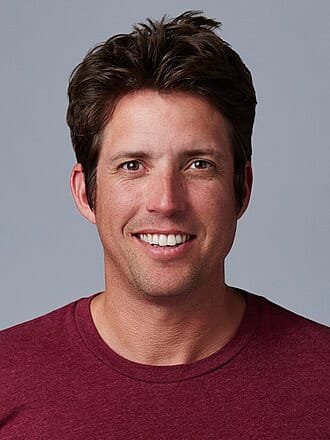
Caption: Nick Woodman as GoPro moved from surf gadget to public company. “Nick Woodman,” via Wikimedia Commons.
Nick Woodman’s origin story sounds like beach-town folklore until the numbers walk in and ruin the argument. A surfer goes looking for a better way to photograph himself on waves, comes back with a wrist strap, sells belts out of a van, and ends up building one of the defining camera brands of the internet age. That premise should have collapsed somewhere between “bro idea” and “retail inventory.” Instead it became GoPro.
What kept it from becoming a beach-town anecdote was Woodman’s particular mix of appetite and fear. He had already flamed out once, then again. He had already lost other people’s money. By the time he found the GoPro concept on a surf trip in 2002, he was not a romantic hero. He was a founder who understood that one more miss would make him the guy with stories, not the guy with a company. That has a way of clearing out the nonsense.
Early Life
Nicholas Woodman was born on June 24, 1975, and grew up in Menlo Park and Atherton, California, in a family that knew both finance and pressure. His father, Dean Woodman, co-founded investment bank Robertson Stephens. His mother, Concepcion Socarras, is of Hispanic descent. Woodman went to Menlo School, then UC San Diego, where he studied visual arts and minored in creative writing. He did not just want to build hardware. He wanted a way to frame experience.
“I failed and deserved to be on f**ckedcompany.” , Nick Woodman, speaking to Forbes about Funbug
Before GoPro, he ran two failed startups. The first tried to sell electronics on razor-thin margins. The second, Funbug, a gaming and marketing business, raised roughly $3.9 million during the dot-com era and then died in the crash. Forbes quoted Woodman looking back on that collapse with painful clarity: he failed, and he knew he deserved the scar. There is nothing glamorous about losing investor money.
The turn came on a five-month surf trip through Australia and Indonesia. He wanted good action photos of himself and his friends, but photographers were too far away and existing gear was too clumsy or too expensive. So he improvised. According to Forbes and CNBC profiles, he rigged a disposable camera to his wrist with pieces of a surf leash. The product idea was born there, half frustration and half stubbornness. Silicon Valley likes to pretend every company starts with a whiteboard. This one started with salt water and annoyance, which is often healthier.
The Business That Made Them
Woodman founded GoPro in 2002, originally as Woodman Labs, and sold the first camera system in 2004. It was not yet the sleek digital action camera people know now. It was a 35mm film camera in a waterproof shell. Primitive, yes. But the concept was already right: put the camera on the athlete, not on the sidelines.

Caption: The first GoPro Hero film camera, the rough draft of a category. “GoPro Hero (film camera), front,” via Wikimedia Commons.
The early numbers show why this idea worked. Forbes reported GoPro did about $150,000 in revenue in 2004, then about $350,000 in 2005. The point is the slope. Specialty retail came first, then broader distribution, then a content engine that made every customer part of the marketing department.
By 2012, Foxconn bought 8.88% of GoPro for $200 million, valuing the company at $2.25 billion. Then came the IPO. GoPro went public in June 2014 and closed its first trading day at $31.34 a share. Later, the stock fell hard, and the market sobered up. Consumer hardware can make you feel like a genius right before it checks your pulse.
Today the business is smaller than its peak hype but still meaningful. GoPro’s May 11, 2026 first-quarter results showed $99 million in quarterly revenue, $27 million in subscription and service revenue, and 2.26 million subscribers. The same release said the board had begun reviewing strategic alternatives. That is not the language of a company coasting on old surf glory. It is the language of a brand still fighting to prove it has another act.
“I can sell anything that I totally believe in but I’m a horrible salesman of something I don’t believe in.” , Nick Woodman, Forbes
The math on Woodman’s wealth follows from that arc. Forbes’ real-time profile put his net worth at $1.2 billion as of July 27, 2026. That figure rests on his remaining GoPro ownership, more than $540 million in stock he has sold since the IPO, and investment returns on those proceeds.
Investment Philosophy
Woodman does not sound like a man who worships “entrepreneurship” as an abstraction. He sounds like somebody who got burned, then built standards around the burn mark. In a 2013 Forbes interview, he said he could sell almost anything he truly believed in. That is not a slogan. It is a filter.
His Reddit AMA in 2015 carried the same instinct in plainer language. Asked about the videos that mattered most to him, he pointed to the early GoPro ski film that made him realize “how big GoPro was about to blow up.” That answer matters because it was about emotion before spreadsheets. Woodman is not allergic to numbers. He just seems to believe the numbers come after conviction, not before it.
That helps explain why his investing style on Shark Tank felt different from Kevin O’Leary’s royalty math or Mark Cuban’s software reflexes. Woodman likes products that a user can feel in ten seconds. He also seems unusually honest about what he does not care about. On Spikeball, for example, he passed because the sport did not connect with him. That can sound sentimental until you watch how often investors light money on fire chasing businesses they do not understand.
On Shark Tank
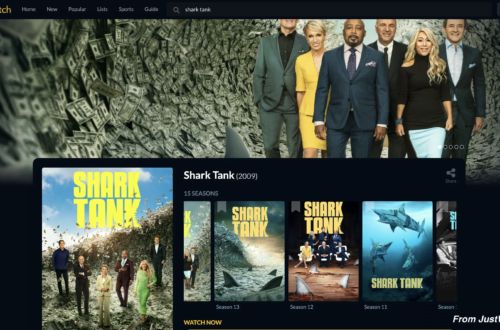
Woodman appeared as a guest shark twice in Season 6, first in Episode 6.10, which aired on November 21, 2014, and then in Episode 6.29, the season finale that aired on May 15, 2015. IMDb lists both episodes with him on the panel, and the show used him exactly the way you would expect: as the surfing founder who had turned a niche object into a mass-market habit.

Caption: Woodman on Shark Tank, where he brought founder empathy and category bias. Image courtesy of GoPro press materials.
His clearest on-air deal came in Episode 6.10 with Kitchen Safe. The founders asked for $100,000 for 5%, a $2 million implied valuation. Lori Greiner and Nick Woodman ended up doing a deal at $100,000 for 20%, which cut the implied valuation to $500,000. That is a sharp reset, down 75% from the ask. The founders took it anyway, which tells you they valued distribution and credibility more than pride. Kitchen Safe is still selling its timed-lock containers, and in this case the down-round-on-TV logic held up.
In Episode 6.29, Woodman joined Mark Cuban and Kevin O’Leary on Shark Wheel. The founders asked for $100,000 for 5%, implying a $2 million valuation. The final deal was $225,000 for 7.5% plus a 10% royalty until $500,000 was repaid. Strip away the royalty for a moment and the equity piece alone values the company at roughly $3 million. Add the royalty and the sharks bought themselves downside protection with upside still intact. That is classic O’Leary structuring with Woodman tagging in on a product that fit his action-sports instincts.
“I just love doing deals with you guys because it closes while I’m still trying to figure out the damn structure.” , Nick Woodman, IMDb quote from Episode 6.29
His best Shark Tank moment may have been a pass. Spikeball eventually became one of the show’s biggest cultural winners, but Woodman walked away because the sport did not connect with him. That miss matters. It shows the limit of investing by personal feel. It also shows the upside of honesty. He did not fake enthusiasm for airtime. There are worse habits on television.
For a broader look at how other guest sharks translate operating success into TV investing, The Shark Monitor’s profile of Candace Nelson is a useful contrast.
Online Presence
Woodman’s personal online profile is lighter than the GoPro brand he built, which makes sense. GoPro is the personality. The man behind it mostly appears when the company has something to say. The official GoPro machine, though, is still large. The company reported 2.26 million subscribers at the end of the first quarter of 2026, and the GoPro YouTube channel remains one of the few brand channels that still looks like a real cultural object instead of a corporate bulletin board in a windbreaker.
That audience tells you what Woodman really built. GoPro stopped being a device story years ago. It became a publishing system for people who want proof that they were there, upside down, in the water, on the cliff, under the bike, beside the lion, or foolish enough to strap a camera to something that probably did not sign a release. The community around GoPro is not following Woodman for hot takes. They are following the footage.
What People Are Saying
Forbes once called him the “mad billionaire” behind GoPro, which was flattering, theatrical, and not entirely wrong. Admirers see obsessive drive. Critics see a founder who rode a brilliant category too long without building the second act fast enough. Both readings can be true.
“He completely wills things into existence.” , Michael Marks on Nick Woodman, Forbes
Reddit and Shark Tank viewers were mixed on his guest-shark run. Some liked that he felt like a real operator rather than a permanent television personality. Others thought his range was narrow, which is another way of saying he knew where he had an edge and where he did not. That is not always fun TV, but it is better investing than pretending every pitch belongs in your wheelhouse.
Net Worth
Forbes estimated Woodman’s net worth at $1.2 billion as of July 27, 2026. The big drivers are straightforward: remaining GoPro equity, cash realized from selling more than $540 million in shares after the IPO, and returns on those realized gains. The Forbes profile also notes that he returned to billionaire status in 2024 after those compounded returns offset years of stock pain.
There is a philanthropic piece here too. Forbes noted that Woodman and his wife donated nearly $500 million worth of GoPro shares in 2014 to a charitable entity at Silicon Valley Community Foundation, and later gave a reported $4 million toward a new community center in Big Sky, Montana. That does not turn him into a saint. It does show that some of the paper wealth got moved into public-benefit channels instead of staying parked on the yacht spreadsheet.
“If I didn’t follow my passion for surfing … I would have never come up with the concept to make a wrist camera.” , Nick Woodman, Forbes
FAQ
Who is Nick Woodman on Shark Tank?
Nick Woodman is the founder, CEO, and chairman of GoPro, and he appeared as a guest shark in Season 6. He joined the panel because he had built one of the most visible consumer hardware brands of the 2010s and brought direct experience in product, media, and retail distribution.
What did Nick Woodman invest in on Shark Tank?
On camera, Woodman backed Kitchen Safe and joined Mark Cuban and Kevin O’Leary on Shark Wheel. He also passed on Spikeball, which later became one of the more memorable “good business, wrong shark” stories from the show.
Why did Nick Woodman start GoPro?
He started it after a surf trip made the problem obvious. He wanted close-up action footage of amateur athletes, but the gear on the market was too limited, too expensive, or too far from the action to do the job.
How much is Nick Woodman worth?
Forbes estimated his net worth at $1.2 billion as of July 27, 2026. That figure is tied to his GoPro holdings, stock-sale proceeds, and investment gains accumulated after the company’s public listing.
Is Nick Woodman still running GoPro?
Yes. As of GoPro’s May 11, 2026 first-quarter results release, he was still serving as founder and CEO, and he was the executive voice behind the company’s push into the new MISSION 1 line, subscriptions, and a board-led review of strategic alternatives.
Final Take
Nick Woodman is a better business story than he is a myth. The myth says he was a surfer dude who got lucky with a camera. The business story is harsher and more useful. He failed twice, found a real product gap, built distribution the slow way, turned customers into marketers, and sold enough stock at the right times to protect his fortune when public-market euphoria wore off. That is not luck. That is product judgment, timing, and a founder who knew when to sell stock instead of his own legend.
As a guest shark, he was credible because he did not pretend to be universal. He liked hardware, brand, and products you could feel in your hands. He passed when he did not have the instinct. He missed one very good business in Spikeball, and that miss is part of the reason his run feels honest. Woodman was never the broadest investor on the panel. He may have been one of the most believable.
[Article last updated: August 2026. Deal terms and company status reflect publicly available information at time of publication.]

Sebastyen
Sebastyen Wolf is our Editor-in-Chief. He is an analyst and entrepreneur with experience working alongside early-stage founders, launching online ventures, and studying the data patterns that shape successful companies. A fan of Shark Tank since Season 1, he now focuses on translating the show’s most valuable insights into clear, practical takeaways for readers.