Blake Mycoskie Net Worth, Shark Tank, and the Founder Who Turned Purpose Into a Category
TL;DR:
– Blake Mycoskie built TOMS around a simple retail bargain with a moral hook, sell one pair of shoes, fund help for someone else.
– His career reset came after a 2006 trip to Argentina, when he saw children missing school because they lacked shoes and decided to turn that problem into a business.
– Appeared as guest shark in Season 12 (2020); he made one on-air deal and treated mission-driven founders like he still remembered the rent.
– Forbes reported in 2023 that his net worth was around $400 million, built across the 2014 Bain deal, later investing gains, and newer ventures including Madefor and ENOUGH.
Contents
– [Early Life](#early-life)
– [The Business That Made Them](#the-business-that-made-them)
– [Investment Philosophy](#investment-philosophy)
– [On Shark Tank](#on-shark-tank)
– [Online Presence](#online-presence)
– [What People Are Saying](#what-people-are-saying)
– [Net Worth](#net-worth)
– [FAQ](#faq)
– [Final Take](#final-take)

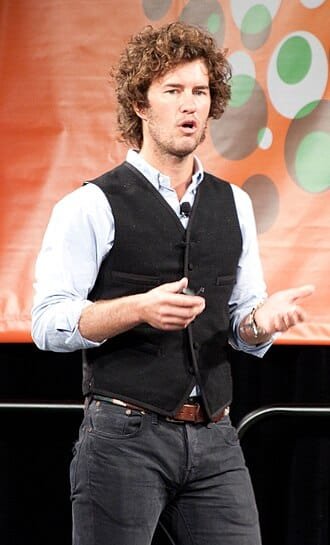
Caption: Blake Mycoskie speaking about TOMS in 2011. Blake Mycoskie at SXSW 2011, via Wikimedia Commons.
Blake Mycoskie did not walk into business through a polished boardroom door. He got there the messier way, through sports, half-finished college plans, a few companies that worked, one company that did not, and a trip to Argentina that changed the direction of his life when he was supposed to be taking a break. That is usually how the big stories begin. They arrive when somebody has finally stopped giving a speech and started paying attention.
By the time most people heard the name TOMS, the brand already looked prepackaged for legend. A relaxed founder. Canvas shoes. A clean moral promise. Buy a pair, help a child. It sounded so neat that people forgot how rare that kind of clarity is in retail. Most founders spend years trying to explain why their company matters. Mycoskie had a sentence that fit on a shoebox.
The interesting part, years later, is not that he built a famous company. It is that he built one powerful enough to change consumer culture, sold half of it at a rich valuation, watched the company buckle under debt after he stepped back, and then had to figure out what was left when the applause went home.
Early Life
Mycoskie was born on August 26, 1976, in Arlington, Texas. Accounts of his upbringing consistently describe a house split between discipline and imagination. His father, Mike, worked as an orthopedic surgeon. His mother, Pam, built a writing career that later became commercially successful. In a Tim Ferriss interview, Mycoskie described his father as the family’s moral center and his mother as the more hands-on nurturer, which sounds like the sort of combination that produces either a preacher or an entrepreneur. He chose the more chaotic option.
As a teenager, he was serious about tennis and attended Southern Methodist University on a partial tennis scholarship. An Achilles injury helped close that lane, and school never quite became the main event. He launched EZ Laundry while still a student, then moved into outdoor advertising with Mycoskie Media, which he later sold to Clear Channel. He also helped launch a reality-TV venture, Reality Central, that reportedly raised $25 million and then folded in 2005. That failure matters. It left him with something more useful than confidence, a sense of proportion.
“My Dad was always kind of like the moral, he was the true north in the family.” Blake Mycoskie, *The Tim Ferriss Show* transcript
That same period also put him on television in a different way. He and his sister Paige finished third on Season 2 of The Amazing Race. He has said the show widened his appetite for travel. Without that taste for motion, the Argentina trip in early 2006 probably never happens.
The Business That Made Them
The origin of TOMS is so well known that it risks sounding fake, except the details are stubbornly specific. On a return trip to Argentina in 2006, Mycoskie noticed the alpargata shoe everywhere and also saw children without shoes who needed them for school uniforms. At a Berkeley Haas talk in February 2024, he recalled writing in his journal and landing on the core idea: sell a version of those shoes in Venice, California, and give a pair to a child in need for each pair sold. “Tomorrow’s Shoes” became TOMS because the full name would not fit on the tag. Retail history is full of expensive consultants. This one came from a notebook.
The company grew fast enough to make disciplined adults nervous. Fortune reported that by 2016 TOMS had annual sales of around $500 million and more than 500 employees. Reuters reported in 2014 that Bain Capital bought a 50% stake at a valuation of about $625 million, including debt. The math on that deal is simple enough to do on the back of a receipt. A $625 million valuation puts half the company at roughly $312.5 million. Forbes reported that the transaction made Mycoskie at least a $300 million man, which is not bad for a founder who started by selling shoes out of his apartment and telling interns to keep posting online.
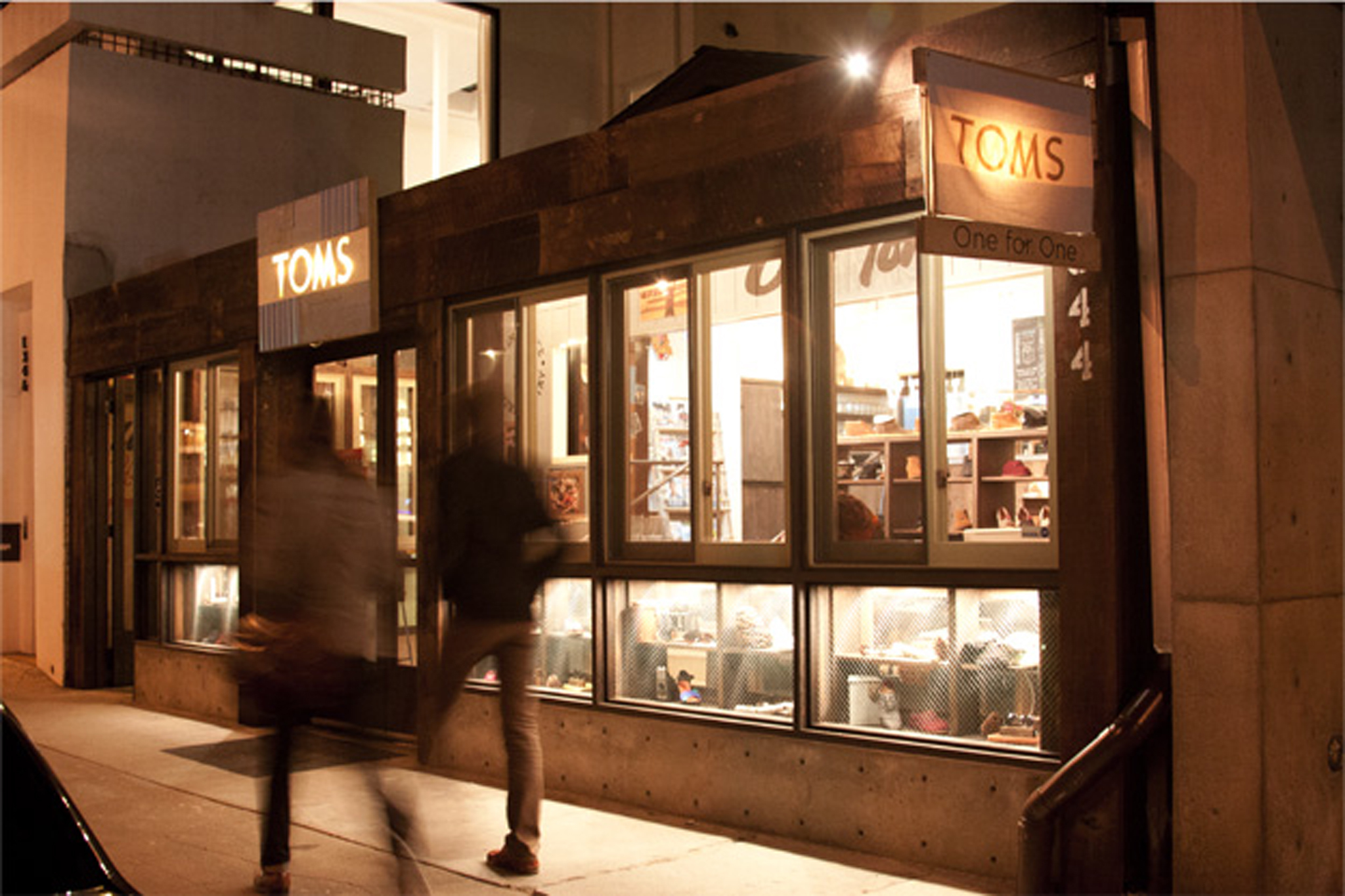
Caption: A TOMS storefront in Venice, Los Angeles, where the brand turned a simple alpargata into a national symbol of feel-good consumerism. Image via Time Out.
There was real business substance underneath the mission language. TOMS spent far less on classic advertising than a normal fashion brand because the giving story did the work of customer acquisition. That mattered. If many consumer brands burn 10% to 20% of margin on marketing, and TOMS could redirect part of that spend into product donation while still keeping the story attractive, then the social mission was not just the ethics. It was also the distribution engine. For a while, that is a beautiful machine.
But beautiful machines can still blow a gasket. By late 2019, Reuters reported that TOMS creditors were taking over the company as it restructured roughly $300 million of debt. That wiped out Mycoskie’s remaining stake. TOMS still operates, and the company says it gives a portion of profits through grants and product donations, while its current impact language says one-third of net profits go to a giving fund. The giving survived. The original balance sheet did not.
Investment Philosophy
Mycoskie talks about business like someone who still thinks purpose should arrive before scale. That can sound soft until you look at how he frames the economics. At Haas, he explained that TOMS became profitable partly because the money many brands would have spent on marketing instead funded impact that customers actually wanted to talk about. That is not airy idealism. It is a clear claim about customer behavior.
He also tends to judge companies by whether they solve a frustration the founder has felt in real life. In that same talk, he said successful companies come from passion, from a need, or from seeing something in the world that feels wrong. That explains why he has spent time after TOMS backing social enterprises, co-founding Madefor, and more recently pushing ENOUGH, his mental wellness nonprofit-linked venture. He likes businesses that are trying to repair something, even if that instinct sometimes makes Wall Street people reach for aspirin.
“Our giving and our commitment to our impact had a greater influence on the customer than any type of marketing we could ever do.” Blake Mycoskie, UC Berkeley Haas Dean’s Speaker Series
The personal side of that philosophy has become more explicit lately. On his ENOUGH site, Mycoskie says his depression worsened after his post-TOMS years and that external success did not fix the deeper problem. His newer message is that achievement without an inner floor can leave a person rich, famous, and still badly lost.
On Shark Tank
On Shark Tank, Mycoskie arrived in Season 12 as a guest shark with a reputation that made immediate sense for the show. He had built a consumer brand, sold part of it at a major valuation, and could talk mission without sounding rehearsed. ABC’s season coverage and the Shark Tank Wiki episode pages show him in Episode 1201 on October 16, 2020, and Episode 1206 on November 20, 2020.
His one confirmed on-air deal came in the premiere with Touch Up Cup, the paint-storage product pitched by Carson and Jason Grill. The ask was $150,000 for 10%, which implied a $1.5 million valuation. Mycoskie offered $200,000 for 25%. That counteroffer valued the business at $800,000 post-money. Daymond John came in lighter on dilution, but the Grills chose Mycoskie. It was a strong example of something people forget on this show. Better terms are not always the winning terms. A founder sometimes wants the investor who sounds like they will actually call back.
Caption: Blake Mycoskie during his Season 12 guest-shark run, where he mixed consumer-brand instincts with a softer edge than the usual blood sport. Image via Rumpl’s Shark Tank feature page.
In Episode 1206, he was part of a panel that heard pitches from Pan’s Mushroom Jerky, K9 Mask, Moment, and Prime 6. He did not leave with another closed deal, but his presence fit best with founders selling a mission as well as a product. That is also why his coverage belongs beside profiles like [Candace Nelson’s guest shark story](https://thesharkmonitor.com/candace-nelson-guest-shark-with-a-purpose/) and [Daniel Lubetzky’s rise on the panel](https://thesharkmonitor.com/daniel-lubetzky-the-kind-shark/).
“No, you don’t understand. This is the most amazing company in the world!” Customer anecdote Blake Mycoskie recounted at UC Berkeley Haas, recalling an airport encounter with an early TOMS buyer
That anecdote was not delivered on the Shark Tank stage, but it explains why his on-air style felt different. He values evangelism. He wants the founder who can create believers, not just buyers.
Online Presence
Mycoskie’s online presence now looks less like a footwear founder’s and more like a post-exit memoir that learned how to use a camera. His official site centers on TOMS, ENOUGH, mental health, speaking, and longer reflections about identity after success. Madefor still presents him as a co-founder, while ENOUGH frames him less as a retailer and more as a public voice on mental health after success.
That shift matters because it tells you where his personal brand has gone. Earlier Blake Mycoskie sold purpose through product. Current Blake Mycoskie sells candor through recovery. The audience is broader now: founders, wellness-minded consumers, people who admired TOMS, and people who suspect success can be a very polished form of panic.
What People Are Saying
The public read on Mycoskie has always split in two. One camp sees the founder who helped make conscious consumerism mainstream. The other sees a businessman whose flagship company eventually proved that a good heart cannot refinance debt.
His most lasting supporters usually focus on the cultural effect. TOMS made charitable giving legible to ordinary buyers in a way that did not require a white paper or a gala. Buy shoes, shoes get given. You can critique the model later. Plenty of people have.
“Blake’s story is a really powerful one.” Ann Harrison, dean of UC Berkeley Haas, introducing Blake Mycoskie in February 2024
That kind of praise is not about footwear. It is about narrative force. Even now, years after the company’s debt mess and the deserved criticism of one-for-one simplification, Mycoskie still gets treated as a founder who altered what a consumer brand could promise. He did not invent virtue in commerce, but he turned it into a consumer-facing sales story that few founders of his era matched.
Net Worth
The cleanest current estimate comes from Forbes in June 2023, when a reported conversation with Mycoskie’s money manager pegged his net worth at about $400 million. That figure makes more sense than the vague billionaire chatter that sometimes floats around founders with famous brands and good lighting. TOMS made him wealthy, but not in the permanent, untouchable way people assume when they hear a founder sold half a company.
Put plainly, the $400 million estimate rests on three buckets: the Bain transaction, the value he realized before the 2019 wipeout, and later investment gains that mattered more than his residual TOMS ownership.
The important editorial point is that his wealth story is stronger than his operating-company story. TOMS as a business stumbled after the private-equity era. Mycoskie as an individual did not.
Frequently Asked Questions
Was Blake Mycoskie a real Shark Tank shark or just a guest?
He was a guest shark, not a permanent panelist. ABC brought him into Season 12 in 2020 as a consumer-brand founder with strong social-impact credentials.
What is Blake Mycoskie’s net worth?
The most credible public estimate is that he was worth around $400 million when Forbes reported on him in June 2023. That figure reflects the Bain-era TOMS payout, later investing gains, and the fact that his remaining TOMS stake was wiped out in the 2019 debt restructuring.
How did Blake Mycoskie make his money?
Most of his wealth came from founding TOMS in 2006 and selling half the company to Bain Capital in 2014. He had earlier wins in laundry and outdoor advertising, but TOMS is the engine that turned him from entrepreneurially restless into genuinely rich.
What happened to TOMS after Blake Mycoskie stepped back?
He stepped down as CEO in 2015, and by 2019 the company’s creditors took control as it restructured about $300 million in debt. TOMS still operates today, but its impact model shifted from the original one-for-one formula to grant-based giving tied to profits.
Did Blake Mycoskie make any deals on Shark Tank?
Yes. His confirmed on-air deal was with Touch Up Cup in Season 12, Episode 1. He offered $200,000 for 25%, which implied an $800,000 valuation after the investment.
Final Take
Blake Mycoskie matters because he built one of the rare businesses that changed not just a category, but the language around buying things. TOMS convinced a generation of consumers that a purchase could double as a small act of moral participation. The promise was powerful, and the numbers were real, but the company eventually ran into the same problem that humbles a lot of admired brands, mission can help sell the product, but it cannot rescue a debt-heavy business.
My judgment is simple. Mycoskie was better at inventing a movement than building a durable capital structure, and that is still a serious achievement. Plenty of founders can manage inventory. Very few can make millions of customers feel like they joined a cause by putting on a pair of canvas shoes. He earned the spotlight, and he earned the scrutiny.
[Article last updated: August 2026. Deal terms and company status reflect publicly available information at time of publication.]

Sebastyen
Sebastyen Wolf is our Editor-in-Chief. He is an analyst and entrepreneur with experience working alongside early-stage founders, launching online ventures, and studying the data patterns that shape successful companies. A fan of Shark Tank since Season 1, he now focuses on translating the show’s most valuable insights into clear, practical takeaways for readers.