Richard Branson Net Worth, Shark Tank, and the Virgin Empire Behind the Guest-Shark Glow
TL;DR: – Richard Branson built Virgin around one stubborn idea, consumer industries get interesting when someone finally treats customers like human beings – His career started with Student magazine, a dyslexic teenager, and a mail-order record business that grew because he noticed what larger companies ignored – Appeared as guest shark in Season 9 (2017 to 2018); he backed Locker Board, joined the Grypmat deal, and brought pure founder energy to the panel – Net worth is publicly estimated at $2.8 billion, built across Virgin equity, travel businesses, telecom, and selective stakes tied to the Virgin brand
Contents
- Early Life
- The Business That Made Them
- Investment Philosophy
- On Shark Tank
- Online Presence
- What People Are Saying
- Net Worth
- FAQ
- Final Take
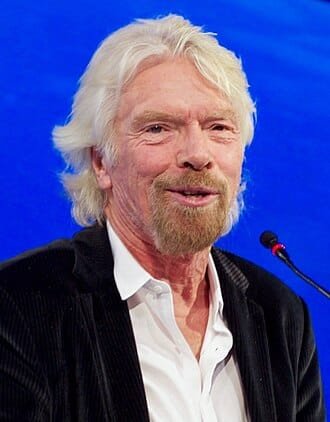
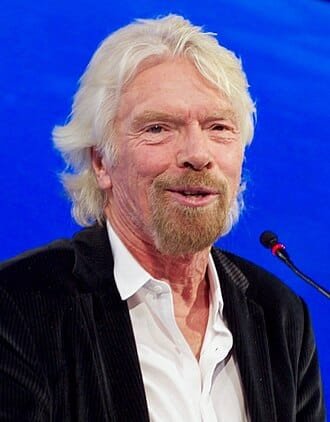 Caption: Richard Branson, long after Virgin became a global brand and still unmistakably the face of it. Photo via Wikimedia Commons.
Richard Branson’s useful origin story does not begin on a private island. It begins with a teenager who left school at 15, launched Student magazine in 1967, and used that audience to sell records by mail. A lot of business mythology gets polished until it squeaks. Branson’s early story still has sawdust on it.
That roughness matters because the later empire can make him look like a mascot for risk. He is more concrete than that. Branson kept noticing industries that treated customers badly, from records to airlines, and he kept betting that people would reward whoever fixed the obvious irritation.
Early Life
Sir Richard Charles Nicholas Branson was born on July 18, 1950, in Blackheath, London. His father, Edward James Branson, was a barrister. His mother, Eve Branson, worked as a flight attendant and later became an entrepreneur. That family mix helps explain him.
Branson has spoken often about struggling with dyslexia and feeling boxed in by formal schooling. That is not a decorative part of the story. It shaped the operating style that followed. He learned to simplify ideas, trust instinct, and judge people quickly because the conventional academic route was not going to rescue him. He left Stowe School at 15, and his headmaster reportedly told him he would either end up a millionaire or in prison. A little British encouragement goes a long way.
His first real business spark came with Student, a magazine aimed at young people during the late 1960s. From there he started a mail-order record business in 1970 with Nik Powell, then opened a physical shop. The Virgin name was chosen because, in Branson’s telling, they were new to business.
“Listen more than you talk. Nobody learned anything by hearing themselves speak.” , Richard Branson, quoted by Forbes from LinkedIn
That quote sounds almost too neat until you place it against his life. Branson was never the classic spreadsheet founder. He was a collector of people, stories, and frustrations. Listening was not just etiquette. It was product research with better manners.
Two more facts matter. He married Joan Templeman in 1989, and they had two children, Holly and Sam. He was knighted in 2000 for services to entrepreneurship. The long arc of his story is less about spectacle than repetition: spot a weak customer experience, recruit strong operators, and see whether the market salutes or throws a chair.
The Business That Made Them
The company that made Branson was not one company. It was the Virgin system. The record business became Virgin Records in 1972. That label signed Mike Oldfield and later the Sex Pistols, which tells you Branson was already good at spotting a market gap and a public mood at the same time. In 1992 he sold Virgin Records to Thorn EMI for about $1 billion.
The next phase is where the numbers become harder to shrug off. Virgin Atlantic’s 2024 financial results showed record revenue of £3.3 billion and a return to profitability, with £20 million in profit before tax and exceptional items. That does not mean Branson personally owns every pound of it, and that distinction matters. But it does show that one of his signature businesses still generates real operating scale, not just nostalgia and airport mood lighting.
 Caption: The Virgin mark became one of the few founder-led brands that could travel from records to airlines without looking completely ridiculous. Virgin logo, via Wikimedia Commons.
Virgin today is better understood as a portfolio and a licensing machine than as a single operating company. The Virgin Group overview describes it as a global growth investor, while the Branson family page says there are more than 40 Virgin companies employing about 71,000 people in over 35 countries. He built a brand that could travel, but the real trick was not style. It was picking a few categories big enough to matter, then surviving the misses long enough for the winners to pay for them.
The math behind his reputation is blunt. Start with Virgin Records selling for roughly $1 billion. Add later value tied to Virgin Atlantic, Virgin Mobile, hotels, cruises, health clubs, and space-related ventures. Not all of those bets worked. Virgin Cola flopped. Virgin Orbit went bankrupt in 2023. But enough of the big bets either exited well or still produce enterprise value that the scoreboard remains in his favor.
Investment Philosophy
Branson is not a valuation purist in the Warren Buffett sense. He is a product-and-founder investor. He likes businesses that treat the customer better, founders who are a little hard to housebreak, and pitches simple enough to fit in a sentence. In a Forbes interview, he argued that if an idea cannot fit on the back of an envelope, it is rubbish.
He also talks about failure with less perfume than many billionaire memoir merchants. In a Forbes piece on business failure, Branson said Virgin had never been completely certain new ventures would succeed and admitted that Virgin Cola failed because the company had not thought the fight through well enough. That is the part worth taking seriously. He is willing to sound wrong in public, which is rare among people who own islands.
“We’ve never been 100% sure that any of the businesses we’ve started at Virgin were going to be successful.” , Richard Branson, Forbes
His personal values sit underneath the commercial talk. The Virgin site frames the company around changing business for good, and the Branson family speaking page notes that proceeds from many of his appearances go to Virgin Unite, the independent foundation tied to the Branson family and Virgin. That does not make him a saint, but it does show that his preferred image is not ruthless efficiency.
The reason Branson worked on Shark Tank is simple. He thinks like a founder who still enjoys the first ten minutes of a company more than the twentieth board meeting. He reads the soft signals fast, but his real filter is simpler: is the problem obvious, is the founder credible, and is the ask low enough to leave room for error.
On Shark Tank
According to the Season 9 episode listings, Branson made his first Shark Tank appearance in Episode 1 and returned in Episode 12. Those two episodes captured him well. He did not try to impersonate one of the regular sharks.
The cleanest deal from his run came with Locker Board, as CNBC reported. Carson Kropfl, then 13, entered asking for $60,000 for 15%, a $400,000 implied valuation. Branson closed at $65,000 for 20%, which reset the implied valuation to $325,000. That is an 18.75% haircut from the ask.
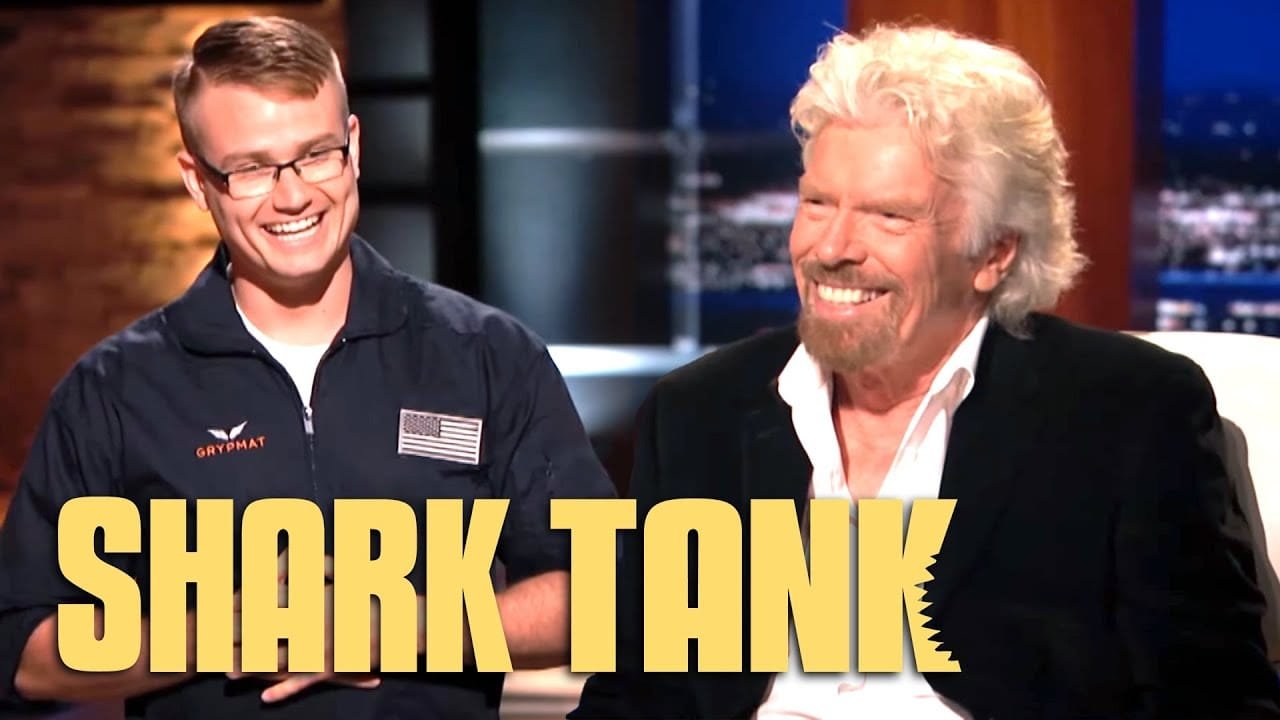 Caption: Branson on the panel during the Grypmat negotiation, where his taste for operator grit fit the pitch perfectly. Image from Shark Tank Global on YouTube.
CNBC later reported that Locker Board had already become a six-figure business and was collaborating with Nike after the show. That matters because Branson backed a founder solving his own problem with a product that could travel.
In Season 9, Episode 12, Branson joined Mark Cuban and Lori Greiner in the Grypmat deal. According to Grypmat’s own recap, Tom Burden walked out with $360,000 for 30%. Against Burden’s $200,000 for 10% ask, the valuation fell from $2 million pre-deal logic to a $1.2 million post-money price.
“And we had a connection, he told me I reminded him of himself when he first started his business.” , Carson Kropfl, CNBC on Richard Branson after Locker Board
The most famous Branson moment on the show was not a term sheet. It was the water-throwing gag with Mark Cuban during the Simple Habit pitch. Funny, yes. Also revealing. Branson treated the set like a live room, not a valuation spreadsheet.
If you want a useful contrast, compare Branson with The Shark Monitor’s profile of Gwyneth Paltrow. Paltrow brought brand discipline. Branson brought founder voltage. On a show that sometimes confuses confidence with competence, Branson usually knew the difference.
Online Presence
Branson’s online presence is still enormous. The Branson family page on Virgin says he has almost 40 million followers across social media and blogs daily. That scale matters because it turns every book launch, climate post, airline announcement, and public-policy opinion into direct distribution.
The community around him is broad. Founders follow him for the origin myth. Travelers know the airline and hotel brands. Climate and philanthropy circles know Virgin Unite and his public advocacy.
What People Are Saying
Branson tends to attract a certain kind of praise. People rarely call him the sharpest financial engineer in the room. They talk instead about nerve and generosity.
“He’s been knighted by the Queen of England. He also owns companies. He owns an island, he owns spaceships.” , Carson Kropfl, CNBC explaining why he chose Richard Branson on Shark Tank
That quote is funny because it sounds like a 13-year-old wrote the perfect summary for a television audience. It is also useful because it captures Branson’s edge. He does not walk into a room as a narrow sector expert. He walks in as a man whose resume buys him attention before he says a word. On television, that is an asset. In business, it only matters if the numbers eventually cooperate.
Net Worth
Forbes listed Richard Branson at $2.8 billion in real-time net worth as of August 6, 2026. That figure is lower than the peak years when public markets were kinder to Virgin-related assets, but it is still a clear billionaire fortune built over decades, not from one lucky listing.
The breakdown is plain. Virgin Records created the first giant cash event. Virgin Atlantic remains a serious operating asset. Virgin-branded holdings across travel, telecom, leisure, and licensing still support the broader balance sheet. There have been hits to the empire, especially Virgin Orbit’s bankruptcy, but Branson’s wealth still rests on a diversified brand portfolio with real commercial history behind it.
Frequently Asked Questions
What season was Richard Branson on Shark Tank?
Richard Branson appeared in Season 9. The episode guide shows him in Episode 1 and Episode 12.
Did Richard Branson make any deals on Shark Tank?
Yes. He made a solo deal with Locker Board and joined Mark Cuban and Lori Greiner on Grypmat. He also took part in one of the show’s most memorable non-deal moments when he splashed water at Cuban during the Simple Habit pitch.
Why did Richard Branson throw water at Mark Cuban?
It happened during the Simple Habit negotiation in Season 9, Episode 1. Cuban had mocked Branson for stepping in, and Branson responded by tossing water at him as a joke. It was theatrical, silly, and very on brand for both men.
How did Richard Branson make his money?
He started with Student magazine, then built a mail-order record business that became Virgin Records. After that he expanded the Virgin brand into airlines, telecom, travel, hotels, leisure, and space-related businesses.
What is Richard Branson’s net worth now?
Forbes estimated Branson’s net worth at $2.8 billion on August 6, 2026. That number moves with the value of Virgin-linked assets, public holdings, and broader market conditions, so it should be treated as a current estimate, not as a fixed lifetime total.
Final Take
Branson worked as a guest shark because he judged like an operator, not a mascot. He was less interested in sounding clever than in whether the founder had found a real customer pain and a market big enough to justify the risk.
He also reminds viewers that a giant brand can be built without pretending every move is genius. Some of Branson’s bets failed loudly. Good. That is what happens when someone actually swings. The final judgment is straightforward: Branson mattered on Shark Tank because he made ambition look practical, and he mattered in business because he turned customer frustration into a repeatable empire.
[Article last updated: August 2026. Deal terms and company status reflect publicly available information at time of publication.]

Sebastyen
Sebastyen Wolf is our Editor-in-Chief. He is an analyst and entrepreneur with experience working alongside early-stage founders, launching online ventures, and studying the data patterns that shape successful companies. A fan of Shark Tank since Season 1, he now focuses on translating the show’s most valuable insights into clear, practical takeaways for readers.